The Psychology of Procrastination: It's Not Laziness, It's Emotion Regulation
Introduction: "I'll Really Start Tomorrow"
There is a task you clearly need to do. You know the deadline, you know it matters, and you know that delaying it will cost you. Yet instead of sitting down at your desk, you open the fridge; instead of opening the document, you pick up your phone. An hour later you snap out of it and repeat the familiar line: "Why is my willpower so weak?"
That self-blame rests on a faulty premise: that procrastination is a problem of willpower or time management. If it were, a better planner, louder reminders, and a firmer resolve would fix it. But anyone who has procrastinated knows those rarely work. The schedule is already packed — and we ignore the schedule anyway.
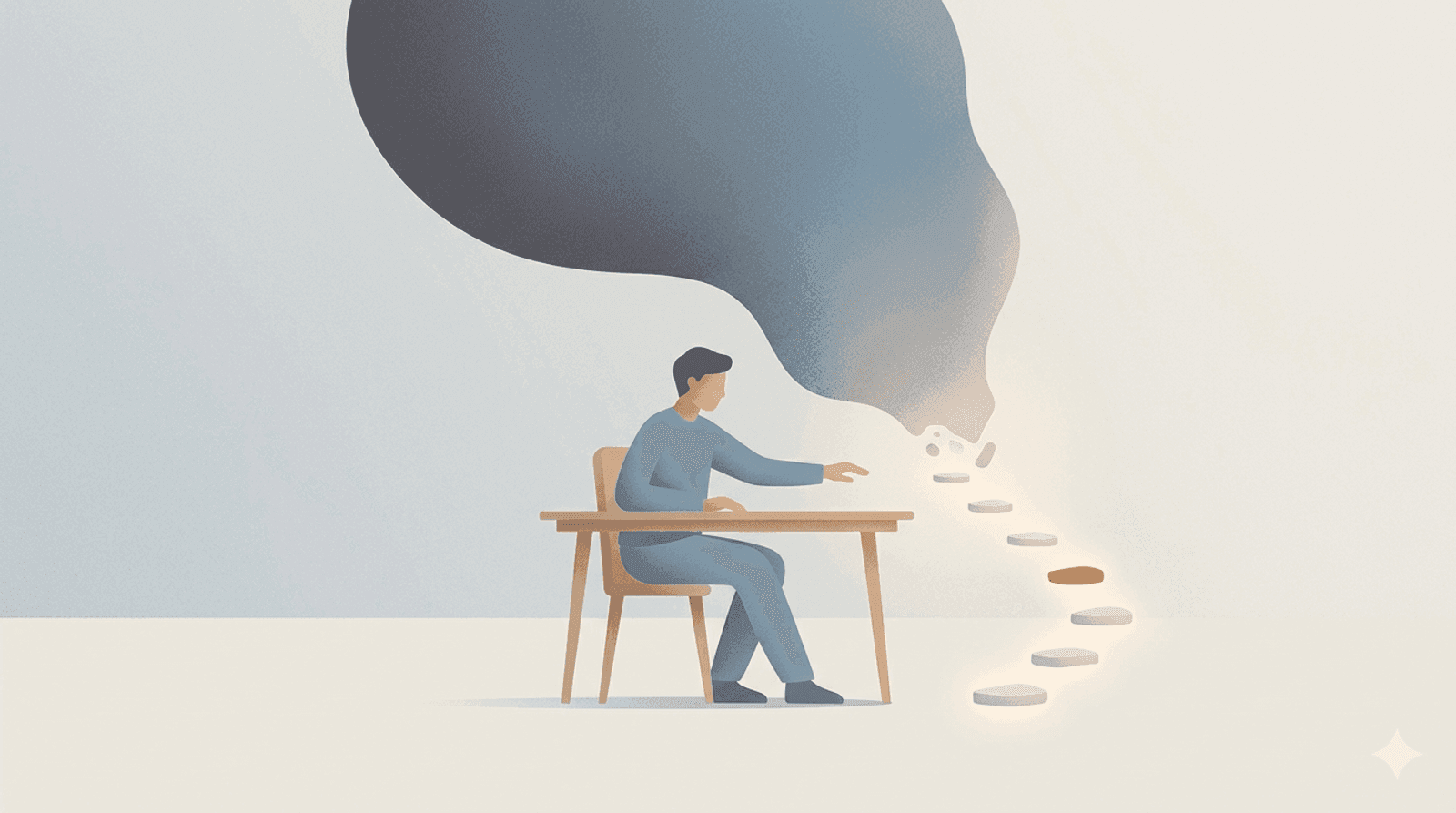
Two decades of psychology research point to a different answer. Procrastination is not laziness, and it is not poor time management. Procrastination is a problem of emotion regulation. More precisely, it is the act of briefly escaping the unpleasant feelings a task stirs up — by passing the cost on to your future self. This article follows that reframing to explain why self-blame makes procrastination worse, and what actually helps.
First, Procrastination Is "Deliberate Self-Harm"
In psychology, procrastination is distinguished from merely being late. In a meta-analysis synthesizing 691 prior studies, Piers Steel of the University of Calgary defined procrastination as "voluntarily delaying an intended course of action despite expecting to be worse off for the delay" (Steel, 2007).
The heart of that definition lies in two phrases: "voluntarily" and "despite expecting to be worse off." Delaying because you lack resources, or because something more important came up, isn't procrastination — it's rational prioritization. True procrastination is avoiding a task while knowing it hurts you — a behavior that is, by definition, irrational. That is why explanations like "I didn't know," "I was busy," or "I had no plan" miss the point. We know, we have a plan, and we still don't do it.
This is exactly what makes procrastination interesting. If we do it knowing it's a loss, the behavior must offer some immediate gain. Identifying that gain is the crux of this article.
It's Not Laziness: The Real Predictors of Procrastination
Steel's meta-analysis distilled the strongest predictors of procrastination (Steel, 2007). Tellingly, "laziness" and "indifference" are not on the list. Instead, the following appeared consistently:
- Task aversiveness: the more boring, difficult, or unpleasant a task feels, the more we delay it.
- Impulsiveness: the more susceptible we are to immediate temptation, the more we delay.
- Low self-efficacy: the stronger the doubt — "can I actually pull this off?" — the more we delay.
- Delay of reward: the further away the reward, the weaker the motivation.
That last item — why distant rewards lose their pull — connects to the problem of temporal discounting discussed in Dopamine and Productivity. Because the brain's motivation system responds far more strongly to nearby rewards, "a good grade a month from now" struggles to beat "comfort right now."
Temperament is tangled in as well. A twin study by Gustavson and colleagues reported substantial genetic overlap between procrastination and impulsivity, interpreting procrastination as an evolutionary byproduct of impulsivity (Gustavson, Miyake, Hewitt, & Friedman, 2014). This result, however, should be read with caution. The study estimated the genetic correlation between the two traits to be near 1.0, but a later study using a different sample found a much weaker correlation of around 0.3. In other words, the evidence is not strong enough to declare procrastination "innate." What is clear is that procrastination is not mere bad attitude but a self-regulation problem entangling several cognitive, emotional, and temperamental factors.
The Key Reframe: Procrastination Manages Mood, Not Time
Here the most important research enters. Fuschia Sirois and Timothy Pychyl redefined procrastination as "a self-regulation failure that prioritizes short-term mood repair" (Sirois & Pychyl, 2013).
The logic runs as follows. Calling a task to mind often brings unpleasant feelings along with it — boredom, anxiety, helplessness, self-doubt, resistance. Procrastination is not avoidance of the task so much as avoidance of the feeling. The moment you pick up your phone, the discomfort lifts and your mood improves, just for a while. The brain learns this instant relief as "successful coping." So the next time a similar feeling rises, it reaches for the same escape.
This view explains why "a better planner" fails. A planner manages time, but it cannot touch the emotion that actually drives procrastination. No matter how finely you arrange the schedule, if the helplessness that surfaces when you think of the task remains unchanged, you will turn away from that schedule again. As long as we treat procrastination as a time-management problem, we keep fixing the wrong thing.
It's worth distinguishing this from the Zeigarnik effect. The Zeigarnik effect is the tension created when a task you have already started remains unfinished, occupying working memory. Procrastination is the stage before that — the avoidance of starting at all. The two are connected but distinct: one is "the tension of the unfinished," the other "the fear of beginning."
The Cost You Hand to Your Future Self
Short-term mood repair comes at a price. As Sirois and Pychyl emphasize, almost the entire cost of procrastination is paid by the "future self" (Sirois & Pychyl, 2013). The present self pockets the relief and hands the burden — the all-nighter before the deadline, the botched work — to tomorrow's self. We treat our future self like a stranger we barely know.
Just how bad this trade is becomes clear in longitudinal research. Dianne Tice and Roy Baumeister tracked college students across a semester (Tice & Baumeister, 1997). Early in the term, procrastinating students actually had lower stress and less illness. The short-term benefit of procrastination was real. But by the end of the term the picture reversed. Procrastinators had higher stress, fell ill more often, and scored lower on every assignment. Summed across the whole term, they were sicker and performed worse.
In short, the relief procrastination offers is not fake — it's genuine. But it is relief borrowed at a high interest rate. The comfort you borrow today is repaid by tomorrow's self in stress, health, and performance.
The Shame Spiral, and Self-Forgiveness as the Exit
Here procrastination's cruelest loop kicks in. After delaying, we blame ourselves: "I put it off again — I'm hopeless." But this self-blame is yet another unpleasant emotion. And if procrastination is a flight from unpleasant emotion, then the feeling that self-blame breeds becomes fuel for the next round of procrastination. Delay → self-blame → greater discomfort → delay again to escape that feeling. The spiral is complete.
The exit from this loop was found in an unexpected place. Michael Wohl and colleagues tracked students who had procrastinated before a first midterm, and found that students who forgave themselves for procrastinating on the first exam procrastinated less before the second (Wohl, Pychyl, & Bennett, 2010). It was not the students who berated themselves, but those who forgave themselves, who changed their behavior.
More evidence points the same way. Sirois showed across four samples that self-compassion mediates the link between procrastination and stress (Sirois, 2014). People lower in self-compassion suffered greater stress from procrastinating. A harsh stance toward oneself amplifies stress, and that stress in turn invites more avoidance.
This adds empirical grounding to the self-acceptance described in I Wanted to Be Someone Who's Okay with Forgetting. Forgiving yourself is not weakness or rationalization — it is a measurable intervention that cuts off the fuel of the spiral. And note that simply naming an unpleasant feeling reduces its intensity, as discussed in The Power of Writing to Quiet the Amygdala — a tool that applies directly to the emotion at the root of procrastination.
The Honest Limits of the Science
For balance, some caveats. The big picture of procrastination research — that procrastination is deeply entangled with emotion regulation — is robust, but the details have limits.
First, methodological limits. Much procrastination research relies on self-report surveys and correlational designs. It is hard to prove cleanly that "emotional avoidance causes procrastination"; the reverse (procrastination worsening emotions) or a third factor could also be at work.
Second, the single-cause trap. Emotion regulation is a powerful explanation, but not the only one. As Steel showed, impulsiveness, self-efficacy, and delay of reward operate alongside it (Steel, 2007). The simplification "just manage your mood and it's all solved" is inaccurate.
Third, not all delay is procrastination. There is strategic delay — deliberately letting a hard problem sit to arrive at a better answer ("incubation"; see the Zeigarnik effect) — and avoidance rooted in perfectionism differs in texture from avoidance rooted in impulsivity. Branding yourself unconditionally as "a procrastinator" is itself inaccurate.
So the right conclusion is not "just feel better." It is to address the emotional barrier and lower the threshold to starting — both at once.
Four Prescriptions to Apply Starting Today
1. Before you procrastinate, name the feeling. The moment you're about to put a task off, pause and ask: "What about this task is uncomfortable right now? Is it helplessness, boredom, or fear of failing?" Naming the emotion lowers its intensity and opens room to choose coping over escape (see The Power of Writing to Quiet the Amygdala).
2. Shrink the first action until it's almost laughable. Task aversiveness scales with the size of the task. "Write the report" is overwhelming; "open the document and write one line for the title" is bearable. As chunking shows, reducing a giant goal to an emotionally light first step removes reasons to avoid it. This aligns with the Zeigarnik finding that simply defining a concrete next action releases the brain's tension (Zeigarnik effect).
3. Make your future self a concrete person. Procrastination gets easier when we treat the future self as an abstract stranger. The more vividly you picture the future scene — "me, next Tuesday at 3 p.m., having to start a presentation with no materials prepared" — the clearer it becomes who today's escape is indebting.
4. Forgive yourself and start again. If you've already procrastinated, don't pile a second pain — self-blame — on top of it. That self-forgiveness reduces future procrastination is an experimentally confirmed fact (Wohl et al., 2010). Reframing from "I blew it again" to "I start again from here" is the fastest way to break the spiral.
How This Applies in MemoryAgent
If procrastination is a problem of emotion, then a helpful tool is not one that pushes more tasks at you, but one that lowers the emotional threshold to getting started. That is precisely the direction MemoryAgent aims for.
- Big tasks into small first actions. When you describe a daunting goal, a conversation with the AI agent can break it down into a concrete first step that carries little emotional weight. When "one step I can take right now" is visible instead of an overwhelming mass, reasons to avoid it shrink.
- Capture without judgment, resurface at the right time. Jot down the "I'll do it later" thought the moment it arises, and the system brings it back at the right moment via spaced repetition. Rather than nagging with a barrage of alerts, it quietly sets the item on your desk.
- Restart instead of self-blame. Rather than showing a missed item as "failed again," it lets you carry on with "begin again here." This is the self-accepting stance described in I Wanted to Be Someone Who's Okay with Forgetting — the same direction as the research showing self-forgiveness changes the next action.
- Carrying the management load for you. The work of "continually remembering that you need to start" is itself invisible management labor. Hand that burden to the system, and you spend less emotional energy just keeping the task in mind.
The Passive Care described in the project's mission meets procrastination right here. Not actively pushing and prodding the user, but a state in which — when you open it — a big task is already broken into a bearable first step. That is the quiet way to lower the emotional barrier to beginning.
Conclusion
- Procrastination is neither laziness nor poor time management. It is a problem of emotion regulation — fleeing the unpleasant feelings a task provokes even while knowing the delay will cost you.
- For short-term mood repair, we hand the cost to our future self. That relief is real, but borrowed at a high interest rate (Tice & Baumeister's longitudinal study).
- The self-blame that follows delay becomes another unpleasant emotion that feeds the spiral. The exit, surprisingly, is self-forgiveness — those who forgave themselves procrastinated less the next time.
- Emotion regulation is powerful but not the only explanation, and much of the research is correlational. Beware oversimplification, but addressing the emotional barrier and the threshold to starting — together — is closest to the answer.
- Four practices anchor the work: name the feeling, shrink the first action, make your future self concrete, and forgive yourself and start again.
References
-
Steel, P. (2007). The nature of procrastination: A meta-analytic and theoretical review of quintessential self-regulatory failure. Psychological Bulletin, 133(1), 65–94. https://doi.org/10.1037/0033-2909.133.1.65
-
Sirois, F. M., & Pychyl, T. A. (2013). Procrastination and the priority of short-term mood regulation: Consequences for future self. Social and Personality Psychology Compass, 7(2), 115–127. https://doi.org/10.1111/spc3.12011
-
Tice, D. M., & Baumeister, R. F. (1997). Longitudinal study of procrastination, performance, stress, and health: The costs and benefits of dawdling. Psychological Science, 8(6), 454–458. https://doi.org/10.1111/j.1467-9280.1997.tb00460.x
-
Wohl, M. J. A., Pychyl, T. A., & Bennett, S. H. (2010). I forgive myself, now I can study: How self-forgiveness for procrastinating can reduce future procrastination. Personality and Individual Differences, 48(7), 803–808. https://doi.org/10.1016/j.paid.2010.01.029
-
Sirois, F. M. (2014). Procrastination and stress: Exploring the role of self-compassion. Self and Identity, 13(2), 128–145. https://doi.org/10.1080/15298868.2013.763404
-
Gustavson, D. E., Miyake, A., Hewitt, J. K., & Friedman, N. P. (2014). Genetic relations among procrastination, impulsivity, and goal-management ability: Implications for the evolutionary origin of procrastination. Psychological Science, 25(6), 1178–1188. https://doi.org/10.1177/0956797614526260