Dopamine and Productivity: Building a Brain-Science-Based Motivation System
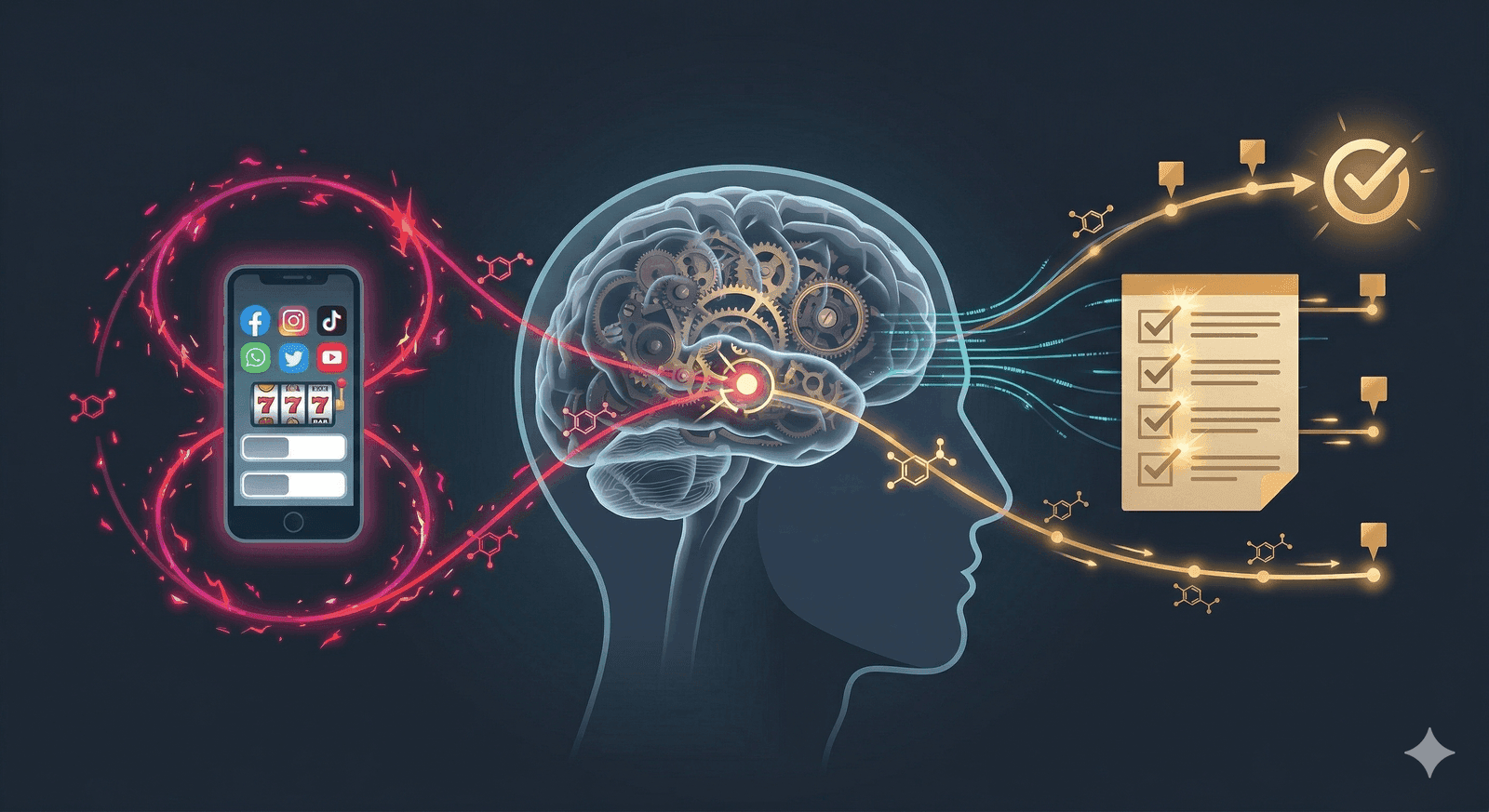
Introduction: Why Scrolling Social Media Is Easy but Studying Is Hard
You sit down to study for just thirty minutes, but before you know it, you're scrolling through social media on your phone. An hour later, you snap out of it and scold yourself: "Why is my willpower so weak?"
This is not a willpower problem. Understanding how the dopamine system works explains why we're magnetically drawn to certain activities and resistant to others. More importantly, by reverse-engineering this system, we can create the same motivational pull around productive activities.
The problem is that most people fundamentally misunderstand dopamine. The equation "dopamine = pleasure chemical" was overturned by neuroscience research beginning in the 1990s. Understanding dopamine's true function is the starting point for solving the productivity puzzle.
Dopamine Is Not the Pleasure Chemical
"Liking" and "Wanting" Are Separate Systems
The research of Kent Berridge and Terry Robinson fundamentally overturned conventional wisdom about dopamine (Berridge & Robinson, 1998). They separated the brain's reward response into two independent components:
- Liking: The actual hedonic pleasure experienced when consuming a reward. This is primarily mediated by the opioid system.
- Wanting: The motivational drive that propels behavior toward a reward. This is what the dopamine system mediates.
Why does this distinction matter? Animals with damaged dopamine systems still show pleasure responses ("liking") when food is placed in their mouths, but they won't seek out food on their own ("wanting"). Conversely, when the dopamine system is hyperactivated, compulsive pursuit occurs even without genuine enjoyment — the neurochemical signature of addiction.
This is why social media is easier than studying. Social media is engineered to continuously stimulate dopamine's "wanting" system: novel feeds, unpredictable notifications, the possibility of social approval. Each element triggers dopamine release. Studying offers no such immediate dopamine stimulation.
The Motivation and Effort Chemical
Salamone and Correa's research further refined our understanding of dopamine's role (Salamone & Correa, 2012). According to their work, dopamine is more critically involved in motivation, behavioral activation, and effort-based decision making than in mediating pleasure.
Simply put, dopamine does not encode "how good something is" but rather "how much effort it's worth." When dopamine levels are low, the brain avoids effortful options and defaults to easy ones. Understanding this as a neurochemical state rather than a personal failing is crucial.
Reward Prediction Error: How Dopamine Actually Works
Schultz's Monkey Experiments
The core operating principle of the dopamine system was revealed through a series of studies by Wolfram Schultz. Across experiments in the 1980s and 90s, Schultz recorded dopamine neuron firing patterns in monkeys receiving rewards under various conditions. In a landmark 1997 paper with Dayan and Montague, these findings were formalized using the temporal difference (TD) learning algorithm from computational reinforcement learning (Schultz, Dayan & Montague, 1997).
The results completely contradicted the "pleasure chemical" hypothesis:
| Situation | Dopamine Response | Interpretation |
|---|---|---|
| Unexpected juice | Strong firing ↑↑ | Positive prediction error: "Better than expected!" |
| Cue → expected juice arrives | No response — | Prediction match: nothing to learn |
| Cue → no juice arrives | Firing suppressed ↓↓ | Negative prediction error: "Worse than expected!" |
Dopamine signals not the reward itself, but the Reward Prediction Error (RPE) — the difference between what was predicted and what actually happened. When reality exceeds prediction, dopamine fires (learning signal: "repeat this behavior"). When reality matches prediction, nothing happens. When reality falls short, dopamine drops (correction signal: "reconsider this behavior").
Why This Matters
This mechanism means dopamine is fundamentally a learning signal. The brain uses dopamine to continuously update "what was better than expected" and adjusts future behavioral priorities accordingly.
This explains why social media notifications are addictive. The uncertainty of whether a "like" will appear — the variable reward schedule — generates constant prediction errors, keeping the dopamine system perpetually activated. Reading a textbook, by contrast, produces few prediction errors. The content falls within expected parameters, so dopamine response is weak.
Active Inference: Dopamine and the Brain's Prediction Engine
The Predicting Brain
Karl Friston's Free Energy Principle places dopamine's role in a broader theoretical context (Friston, 2010). According to this framework, the brain is fundamentally a prediction machine. It continuously generates internal models of the world and strives to minimize the discrepancy (prediction error) between these models and incoming sensory data.
Extending this framework, subsequent research has proposed that dopamine may encode the precision of prediction errors — essentially signaling to the brain "how seriously should I take this prediction error and update my internal model?" (Friston et al., 2012).
Dopamine Beyond Reward
From this perspective, dopamine is not confined to reward contexts. Novel information, surprising events, violated expectations — whether positive or negative, any situation where predictions prove wrong engages the dopamine system. The thrill of learning something new, the excitement of a plot twist in a novel, the exhilaration of exploring an unfamiliar city — all are dopamine responses to prediction errors.
Learning feels engaging when predictions are frequently revised. Learning feels boring when everything falls within expected parameters. True learning is a continuous stream of surprises, and dopamine is the engine that responds to those surprises by updating the brain's internal model.
The Dopamine Trap: How the System Gets Hijacked
Understanding the dopamine system also reveals why certain technologies and services are so effective at capturing our time.
Variable Reward Schedules
Slot machines, social media feeds, and email notifications share a critical feature: the timing and magnitude of rewards are unpredictable. Sometimes "likes" pour in; sometimes there's nothing. This unpredictability generates continuous prediction errors that keep the dopamine system perpetually active.
Immediate vs. Delayed Rewards
The dopamine system responds more strongly to temporally proximate rewards (temporal discounting). A social media "like" is instant; the rewards of studying (passing an exam, growing competence) arrive weeks or months later. The brain's default setting favors the immediate reward.
Tolerance
When the same reward repeats, the brain learns to predict it, and as the prediction error vanishes, so does the dopamine response. The search for stronger stimulation begins — a vicious cycle. This is the neuroscience of "boredom."
Reverse Engineering: Designing a Dopamine-Friendly Productivity System
Understanding how the dopamine system operates allows us to intentionally design the same mechanisms around productive activities.
1. Decompose Goals to Create Frequent Prediction Errors
A large goal ("Master English") offers rewards too far in the future for strong dopamine response. Using chunking strategies to break it into 3-5 sub-tasks creates positive prediction errors with each completion. "That was faster than I thought" or "I actually finished this sub-task" triggers dopamine release and sustains motivation for the next step.
2. Visualize Progress
Progress bars work because of the dopamine system. Even a small increment from 30% to 31% registers as "closer to the goal than expected" — a positive prediction error. Checking items off a to-do list, maintaining a streak, watching a completion counter rise — all leverage the same principle.
3. Maintain Optimal Challenge — Introduce Novelty
If prediction error drives learning, completely predictable tasks generate no dopamine. This aligns with Mihaly Csikszentmihalyi's concept of Flow: too easy produces boredom (no prediction errors), too hard produces anxiety (excessive negative prediction errors). Challenges slightly above current ability generate the most positive prediction errors.
Even with the same learning material, switching methods activates novelty-driven dopamine: reading → writing → explaining → active recall. Each modality shift creates a different cognitive challenge and fresh prediction errors.
4. Close "Open Loops" to Resolve Dopamine Debt
As we explored in our post on the Zeigarnik Effect, unfinished tasks create persistent tension in the brain. From the dopamine system's perspective, this tension represents sustained negative prediction error: "This should be done but it isn't." Even completing a small task resolves this tension, and the resolution itself provides a dopamine reward.
Application in MemoryAgent: Building a Cognitive Environment Using Reward Systems
MemoryAgent leverages the brain's reward principles to provide a cognitive environment that helps users focus on gradual achievement over cheap rewards and maintain sustainable motivation.
Automatic Goal Decomposition for Frequent Completion Experiences
When users share a large goal, the AI agent helps them think through and organize it into manageable steps through natural conversation. As these smaller steps are completed one by one, each 'small win' builds momentum and helps sustain motivation throughout the journey.
Spaced Repetition for "Surprise" Opportunities
The Spaced Repetition algorithm manages review timing so that users experience "Oh, I had forgotten about this!" — a positive prediction error. Combined with active recall, successful retrieval provides a sense of achievement ("I remembered more than I expected!"), while retrieval failure provides a useful "I need to reinforce this" learning signal.
Daily Briefing for Progress Visualization
The daily AI briefing summarizes yesterday's achievements and today's tasks, allowing users to objectively track their progress. Feedback like "You completed 3 sub-goals yesterday" helps focus on incremental progress and acts as a healthy motivational trigger for today's actions.
Policy-Based Self-Regulation and Metacognition
When users set personal principles (e.g., "No social media after 10 PM"), the AI remembers and gently reminds them when behavior conflicts with their stated rules. This provides a metacognitive intervention before the dopamine trap engages, creating an opportunity to rationally reassess the pull of immediate rewards and regulate one's own behavior.
Conclusion
Dopamine is not the pleasure chemical. Dopamine is the brain's prediction error signal, a regulator of motivation and effort, and a learning engine. The dopamine system responds not to "what was good" but to "what was different from expected," using that information to continuously update the brain's internal model of the world.
Understanding this principle enables two things. First, it explains why certain activities become addictive: variable reward schedules, instant feedback, and unpredictability hijack the dopamine system. Recognizing these patterns allows you to consciously disengage.
Second, it allows you to apply the same principles to productive activities: decompose large goals into small units for frequent completion experiences, visualize progress, introduce appropriate novelty, and record unfinished tasks in an external system to close open loops. The dopamine system is not your enemy — properly designed, it becomes your most powerful productivity tool.
Start building your dopamine-friendly goal system at MemoryAgent now →
References
-
Schultz, W., Dayan, P., & Montague, P. R. (1997). A neural substrate of prediction and reward. Science, 275(5306), 1593-1599. https://doi.org/10.1126/science.275.5306.1593
-
Berridge, K. C., & Robinson, T. E. (1998). What is the role of dopamine in reward: hedonic impact, reward learning, or incentive salience? Brain Research Reviews, 28(3), 309-369. https://doi.org/10.1016/S0165-0173(98)00019-8
-
Salamone, J. D., & Correa, M. (2012). The mysterious motivational functions of mesolimbic dopamine. Neuron, 76(3), 470-485. https://doi.org/10.1016/j.neuron.2012.10.021
-
Friston, K. (2010). The free-energy principle: a unified brain theory? Nature Reviews Neuroscience, 11(2), 127-138. https://doi.org/10.1038/nrn2787
-
Friston, K. J., Shiner, T., FitzGerald, T., Galea, J. M., Adams, R., Brown, H., Dolan, R. J., Moran, R., Stephan, K. E., & Bestmann, S. (2012). Dopamine, affordance and active inference. PLoS Computational Biology, 8(1), e1002327. https://doi.org/10.1371/journal.pcbi.1002327