I Didn't Want to Become Better at Remembering. I Wanted It to Be Okay to Forget Sometimes.
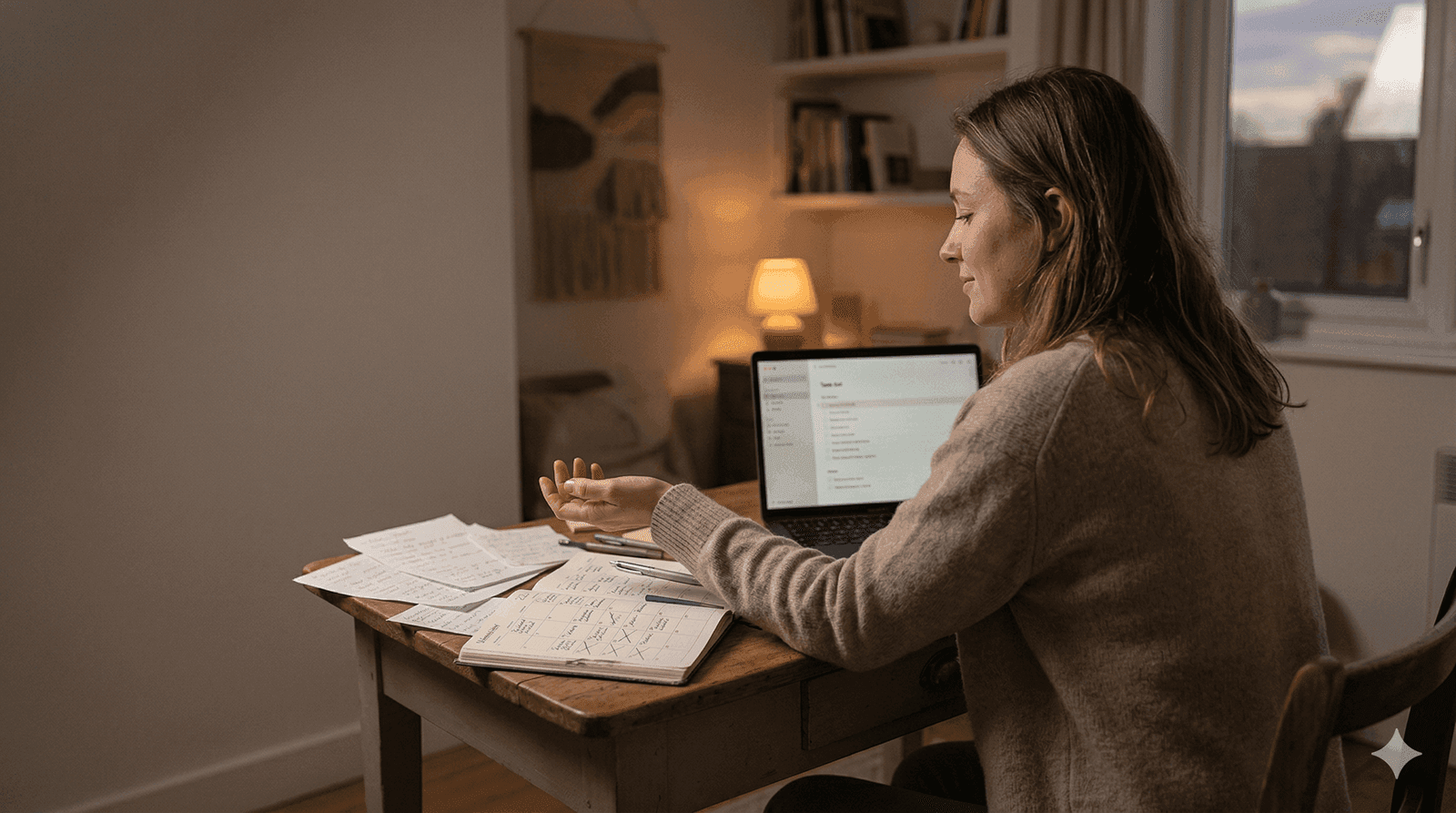
Introduction: Forgetting Stays With Us Longer Than We Expect
We forget things all the time. A task we meant to finish, a message we meant to reply to, an idea we wanted to return to later, a note that felt important when we wrote it down. Some of these are small. Some disrupt the day. Some make relationships feel awkward.
The problem is that forgetting rarely ends as a small inconvenience. After a few misses, people begin to doubt themselves. "Why did I forget that too?" "What if I miss something important again?" "Do I look careless to other people?" The mistake itself passes quickly, but the self-doubt tends to linger.
That is why many people try to hold on tighter. More notes, more reminders, another task app, another calendar cleanup. But strangely, all that effort does not always make life feel lighter. Sometimes it only adds one more system to manage.
What We Need May Not Be Stronger Willpower
People who forget things are often told to be more disciplined, more organized, more careful. That advice is not entirely wrong. But in many cases, the real problem is not a lack of character. It is that there are simply too many things to keep active in the mind at once.
Work keeps moving. Life keeps moving. Thoughts that were never fully sorted remain in the background. In that state, forgetting is less a personal failure than a predictable outcome. And yet people often blame themselves first.
Maybe what we need is not to become flawless, but to live in an environment where we do not have to grip everything so tightly. Not a life where safety depends on remembering every detail, but a life where we can set something down for a moment and still trust that it will be there when we need it again.
Good Tools Should Feel Quiet
This changes the standard for what a good tool is. The real question is not how impressive it looks or how many features it has. The real question is whether it reduces the amount of energy a day consumes.
The tools that truly help usually do not keep announcing themselves. They do not constantly interrupt. They do not demand that the user maintain a perfect system. They quietly separate what matters now, what matters later, and what can safely wait. Then they make those things easier to return to.
When a tool works well, the feeling is often not "this is amazing." It is closer to "I feel a little less anxious." The change can look small from the outside. But the day ends with slightly less fatigue, slightly less mental checking, slightly less fear of having missed something important. That is often what real help looks like.
What We Wanted to Build
This is also why we try not to describe Memory Agent in exaggerated terms. It is not here to live for people or make life decisions for them. A more honest description is that it helps keep notes, tasks, and things worth revisiting in a more organized place, so they are easier to return to when needed.
The important thing is not the visibility of the technology. It is whether the user's burden becomes smaller. Less time spent wondering what comes first. Less time spent trying to remember where something was written down. Fewer moments of "I know this mattered, but I lost track of it."
That is the kind of help we care about: things already a little more prepared, a little more sorted, a little less fragile.
Conclusion: Not a Perfect Memory, but a More Forgiving Life
People forget. More when tired. More when busy. More when life gets complicated. So maybe the goal does not need to be becoming someone who never forgets.
Maybe the more realistic hope is this: a life where forgetting does not immediately become failure, where lost track can be recovered quickly, where important things do not disappear just because they are no longer being actively held in mind.
I did not want to become better at remembering. I wanted it to be okay to forget sometimes. That feeling is where this essay begins, and it is close to what we want our product to support.
See how Memory Agent aims to make everyday life feel a little less heavy ->