Why You Forget Why You Walked In: The Doorway Effect and Context-Dependent Memory
Introduction: The 3-Second Blank at the Kitchen Door
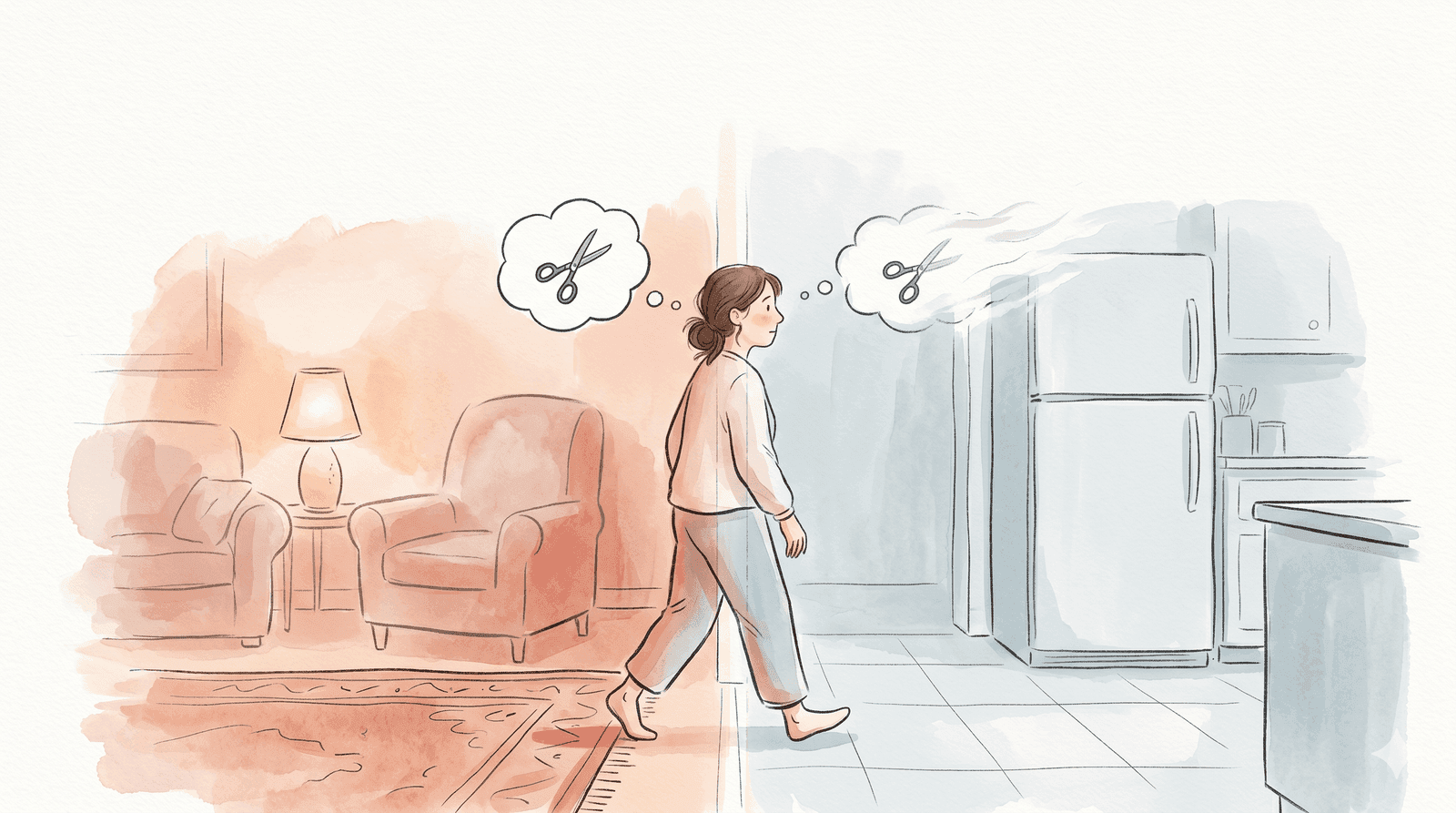
You got up from the couch thinking, "I need to grab the scissors." You cross the threshold into the kitchen and — gone. What were you coming for? You walk back to the living room and, the moment you're back, it pops up: "Right, scissors." Three seconds of staring at a drawer, two seconds blank in front of the open fridge. Several times a day, every day. This is not absent-mindedness, and it is not a failure of concentration.
Cognitive science has been documenting this effect for decades under two names: the Doorway Effect and, more broadly, context-dependent memory. Most of the moments we describe as "I can't remember" are not moments when information has been lost. They are moments when the cues that lead back to the information have been lost. This article traces that mechanism through experimental psychology, explains why retrieval is harder than recording, and shows how this structural limit can be compensated for by external systems.
The Doorway Effect: Why Thresholds Interrupt Retrieval
Radvansky's experiment — same distance, but the door matters
At the University of Notre Dame, Gabriel Radvansky and colleagues quantified this phenomenon in a sequence of experiments, first in virtual environments and then in real rooms (Radvansky & Copeland, 2006; Radvansky, Krawietz, & Tamplin, 2011).
The design is disarmingly simple. A participant picks up an object from a table, then carries it either to another table in the same room or to a table in a different room reached by walking through a doorway. The walking distance is matched. On arrival, they are asked: "What are you carrying?"
The results were consistent. Accuracy dropped and reaction times rose in the doorway condition. The same number of steps, but the presence of a single threshold between start and finish was enough to disrupt retrieval from working memory. The effect replicated in real physical space — so it is not an artifact of VR rendering. It is a feature of the brain.
Why a door — Event Segmentation Theory
Radvansky's interpretation draws on Jeffrey Zacks's Event Segmentation Theory (Zacks, Speer, Swallow, Braver, & Reynolds, 2007). The brain does not store ongoing experience as a continuous stream. It detects changes in time, space, goals, and causality, and uses those changes to carve experience into discrete events. The points where this carving happens are called event boundaries, and when the brain crosses one, it performs a kind of reset: the previous event closes, a new event opens.
Spatial transitions — and doorways are among the clearest of them — are among the strongest signals the brain uses to mark event boundaries. The moment you cross a threshold, your brain registers "this is a different scene," and the intentions, objects, and plans that were foregrounded in the previous event are reclassified as belonging to the past event and pushed out of the active working memory model. The information is not erased, but within the currently active event model it is no longer in the front row. It is tempting to add "…which is why walking back into the living room makes it pop back," and that daily experience is real — but the experimental picture is more careful. Radvansky et al. (2011) found that simply returning to the original room did not restore performance, so cue re-exposure can sometimes help but a physical return is not an automatic retrieval fix.
The Doorway Effect is therefore not a bug. It is a byproduct of the brain's event-based information economy. If every experience were maintained as one continuous blob, working memory would overflow instantly. As we saw in Chunking Strategy, working memory capacity is roughly four items — the cost of that compact capacity is exactly this kind of eventful pruning.
Context-Dependent Memory: Retrieval Lives on Cues
Godden and Baddeley — words learned underwater are recalled better underwater
If the Doorway Effect shows the principle at a scale of seconds, context-dependent memory extends the same logic to minutes, hours, and places. The most famous demonstration is the 1975 diving study (Godden & Baddeley, 1975).
Alan Baddeley and Duncan Godden recruited divers near Oban in Scotland. Participants memorized a list of words either on land or underwater at six meters depth. They were then tested for recall either on land or underwater. The four-cell design produced a clean result:
- Encoded on land, recalled on land: best performance
- Encoded underwater, recalled underwater: similar high performance
- Encoded on land, recalled underwater: approximately 40% drop
- Encoded underwater, recalled on land: approximately 40% drop
When the encoding and retrieval contexts mismatched, recall collapsed. The memory itself was still in the brain, but the environmental cues needed to pull it out were gone.
One caveat needs to be added before leaning on this classic result too hard. A 2021 direct replication by Jaap Murre failed to reproduce the original's context effect under essentially the same procedure (Murre, 2021). The widely quoted "≈40% drop" figure should therefore be read conservatively in light of the most recent evidence. That said, the broader literature does not vanish along with the single replication: Steven Smith and Edward Vela's meta-analysis across many studies concluded that environmental context effects, while variable in size, appear reliably — if modestly — in free-recall tasks and cue-rich environments (Smith & Vela, 2001). In recognition tasks the effect shrinks, because the test item itself acts as a powerful retrieval cue and reduces the relative weight of environmental context.
Tulving's Encoding Specificity Principle — why cues are everything
Endel Tulving and Donald Thomson formalized this intuition into the Encoding Specificity Principle (Tulving & Thomson, 1973).
In short: information is not stored alone. Each memory is bundled with the context of its encoding — the place, the mood, the sounds, the people nearby, even the other thoughts in your head at the moment. Later, to retrieve that memory, the cues present at retrieval must overlap sufficiently with those original contextual features. More overlap, easier retrieval. Less overlap, and you land in the familiar "I know this, I just can't pull it up" state.
The principle explains a great deal of daily experience:
- At a reunion, seeing a friend's face after 20 years floods you with forgotten middle-school episodes — a bundle of place and person cues has been restored.
- In the exam hall, answers that flowed easily in your study room suddenly freeze — the encoding context (study room) and the retrieval context (exam hall) diverge.
- A single smell unlocks a whole childhood scene (the so-called Proustian phenomenon) — because olfactory cues are unusually potent contextual anchors.
The experience described in Why Stress Makes You More Forgetful — the mind going blank under pressure — can be read as a joint effect of this contextual dependency and stress-induced retrieval suppression.
What Was Lost Was the Cue, Not the Information
Together, the Doorway Effect and context-dependent memory give us a sharper way of speaking about everyday forgetting:
When we say "I can't remember," the information is almost always still there. What has disappeared is the trail of cues that leads to it.
This reframing overturns the usual instinct to "improve memory." If forgetting-across-a-threshold is a structural feature of the brain, trying to overpower it by training is a losing proposition. It is cheaper and far more reliable to pre-position cues in the environment. As argued in Distributed Cognition, cognition does not live only inside the skull. It extends across notes on the desk, sticky notes on the fridge, phone notifications — the entire environment is part of the thinking system.
This is not a rhetorical flourish. Prospective memory research has shown that event-based tasks (rich in external cues) dramatically outperform time-based tasks (dependent on internal monitoring), and that this gap widens with age. Internal monitoring is fragile — it degrades with age, fatigue, and cognitive load. External cues anchored to the right context are indifferent to those variables.
Design Principles for "Something That Reminds You"
Translating context-dependent memory into actual tools produces three design principles.
1. Cue placement beats recording
"I'll write it down so I can look at it later" is only half the work. Recording improves encoding, but if no cue exists at the retrieval context, the note will never resurface. A sticky note on the fridge, an umbrella hung on the front door handle, tomorrow's documents stacked on top of your bag — the shared feature is that the cue is planted in the context where the intention has to fire. In digital tools, this role is played by location-based notifications, time-based reminders, and context-driven resurfacing.
2. Exploit event boundaries
If the brain closes the previous event at a threshold, the symmetric move is to plant your cue at the start of a new event, so that it enters the new event in the front row. Getting off the subway, opening the front door, finishing lunch — these are already event boundaries the brain is using to reset attention. Attaching an intention to one of these natural breakpoints leverages existing neural machinery. This is why Gollwitzer's implementation intentions — plans in the form "If X happens, I will do Y" — are so effective (Gollwitzer, 1999). They are, in effect, event-boundary contracts.
3. Passive Care
The most important principle: the user should not have to actively open the system to find the cue. The cue should already be on the desk. A notebook you have to remember to re-read is useless at the exact moment you need it, because remembering to re-read is itself the prospective memory failure we started with. A good external memory system does not ask the user "what have you forgotten right now?" It arranges things so that when the right context arrives, the right thing is already there.
This is why MemoryAgent aims to be less a notebook and more a quiet assistant that "remembers for you, and reminds you on your behalf." Lowering the cost of recording, and building toward retrieval that resurfaces as the context arrives — that is one practical direction for compensating the structural weakness of context-dependent memory. Becoming someone who is free to forget is not about superhuman recall. It is about gradually building an environment that helps the retrieval along for you.
Five Habits for Designing Your Own Cues
-
Record the moment it arises — but design so you don't have to return to the record. Input is cheap; resurfacing is what matters. A note with no path back is no different from a passing thought.
-
Bind intentions to events, not to clocks. "Take medication at 3 PM" is weaker than "take medication the moment I finish lunch." Meal-end is an event boundary your brain already marks.
-
Place cues where retrieval needs to happen. Tomorrow's documents go not on the shelf but on top of your bag. Medication goes not in the cabinet but next to the toothbrush. The location of the cue changes the retrieval rate.
-
Have a "closing ritual" before a big context switch. One second before crossing a threshold, say out loud "I am going to get ___". It re-anchors the intention in working memory and is among the cheapest practical ways to reduce the Doorway Effect's bite. Small habit, outsized payoff.
-
Evaluate digital tools by resurfacing, not recording. The test of a good tool is not how gracefully you can capture things. It is how quietly the right thing reappears at the right moment.
Conclusion
Forgetting after you walk through a door is not the brain malfunctioning. It is evidence that the brain parses continuous experience into events in order to manage it at all. Context-dependent memory and the encoding specificity principle extend this insight into a more modest but still powerful claim: a great deal of everyday remembering is a cue-dependent process.
Accept that framing, and a large share of memory problems shifts from being "a capacity problem" to being a cue-design problem. The solution is not only to train the brain, but also to place cues — with care, in the right contexts — into the environment and tools the brain already leans on.
A quiet assistant that puts the right thing on the desk before you ask for it — one that, at exactly the moment your internal trail of cues goes cold, lays down a new cue on your behalf — lines up naturally with the direction the research cited here points toward.
References
-
Radvansky, G. A., & Copeland, D. E. (2006). Walking through doorways causes forgetting: Situation models and experienced space. Memory & Cognition, 34(5), 1150–1156. https://doi.org/10.3758/BF03193261
-
Radvansky, G. A., Krawietz, S. A., & Tamplin, A. K. (2011). Walking through doorways causes forgetting: Further explorations. Quarterly Journal of Experimental Psychology, 64(8), 1632–1645. https://doi.org/10.1080/17470218.2011.571267
-
Zacks, J. M., Speer, N. K., Swallow, K. M., Braver, T. S., & Reynolds, J. R. (2007). Event perception: A mind-brain perspective. Psychological Bulletin, 133(2), 273–293. https://doi.org/10.1037/0033-2909.133.2.273
-
Godden, D. R., & Baddeley, A. D. (1975). Context-dependent memory in two natural environments: On land and underwater. British Journal of Psychology, 66(3), 325–331. https://doi.org/10.1111/j.2044-8295.1975.tb01468.x
-
Tulving, E., & Thomson, D. M. (1973). Encoding specificity and retrieval processes in episodic memory. Psychological Review, 80(5), 352–373. https://doi.org/10.1037/h0020071
-
Smith, S. M., & Vela, E. (2001). Environmental context-dependent memory: A review and meta-analysis. Psychonomic Bulletin & Review, 8(2), 203–220. https://doi.org/10.3758/BF03196157
-
Murre, J. M. J. (2021). The Godden and Baddeley (1975) experiment on context-dependent memory on land and underwater: A replication. Royal Society Open Science, 8(11), 200724. https://doi.org/10.1098/rsos.200724
-
Gollwitzer, P. M. (1999). Implementation intentions: Strong effects of simple plans. American Psychologist, 54(7), 493–503. https://doi.org/10.1037/0003-066X.54.7.493