Why Paper Notebooks Haven't Disappeared: The Cognitive Limits of Digital Notes and Where They Can Be Improved
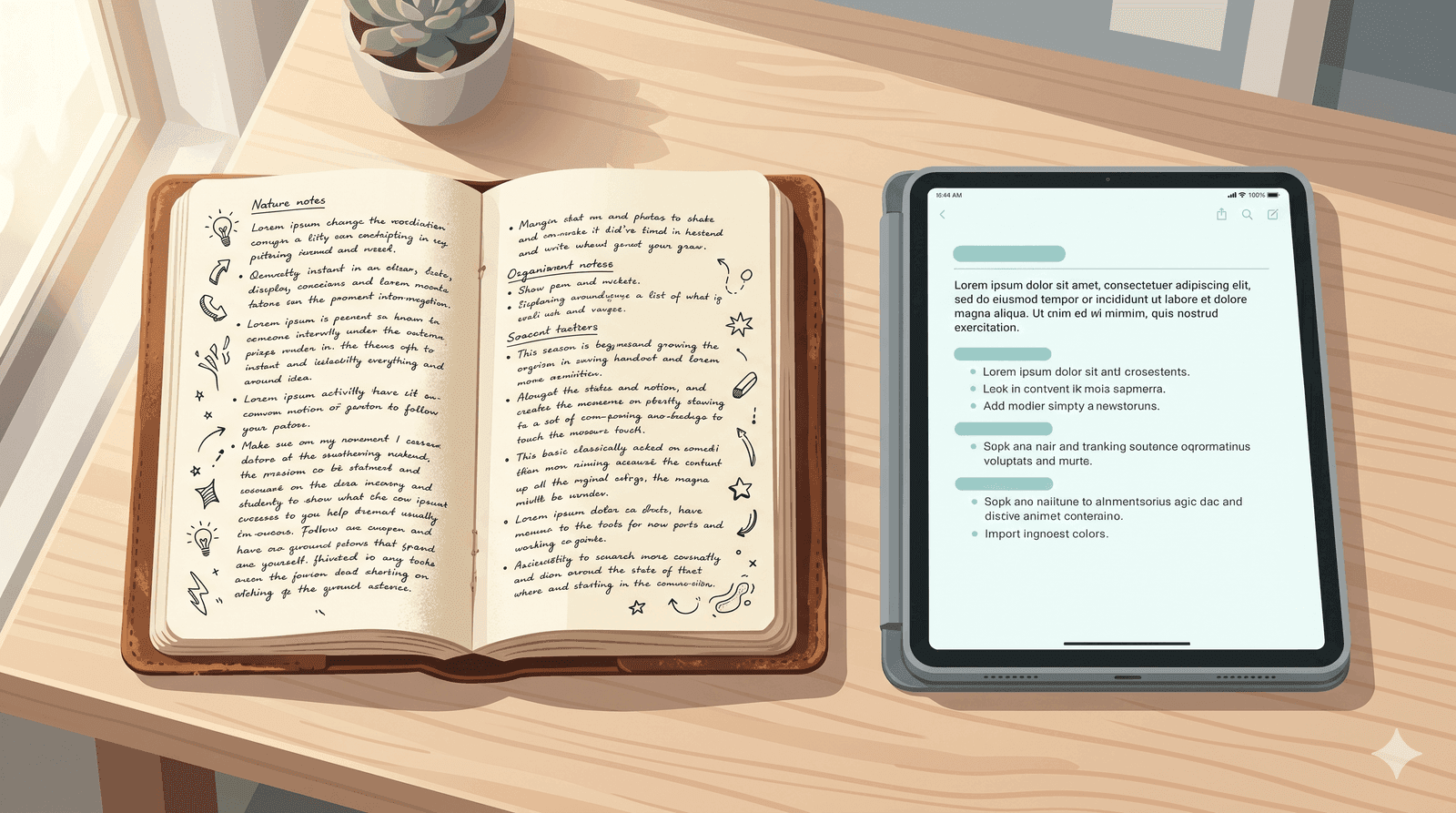
Introduction: Why Paper Notebooks Are Still Around
Smartphones, tablets, and cloud-based note apps have been part of everyday life for more than a decade. And yet the stationery aisle in bookstores hasn't shrunk, and you can still find people taking handwritten notes in meetings. Almost no one thinks digital is less convenient. If paper has nevertheless survived, nostalgia and habit are probably not the whole story.
This article does not argue that paper is superior or that digital is inferior. The two media have different cognitive characteristics, and digital note tools so far have tended to leave some of those characteristics relatively untouched. The goal here is to look at how the medium of a note shapes what happens to it in memory, and to consider where thoughtful improvement is possible.
Five Places Where Digital Notes Are Relatively Weak
1. Unlimited storage creates a "capture trap"
A paper notebook has a finite number of pages, which quietly forces you to decide what is worth writing down. Digital notes have effectively unlimited storage. This is mostly an advantage, but it also produces a subtle shift in attitude: "I'll just save it for now."
Cognitive psychology describes this as one facet of cognitive offloading. Research has repeatedly shown that the act of saving something can reduce the attention and encoding we devote to it. Henkel's 2014 study, for example, found that museum visitors who photographed exhibits remembered them less accurately than visitors who simply looked at them (Henkel, 2014). The act of capturing seems to send the brain a quiet signal: "you don't have to hold this yourself anymore."
The evidence is not one-directional. Storm and Stone (2015) found that saving a file before studying new material actually improved memory for the new material, presumably because saving frees up working memory (Storm & Stone, 2015). The two findings are not in conflict: saving tends to weaken memory for what was saved, while opening room to learn what comes next.
The issue for digital notes is that this "you don't have to hold it" state applies to nearly everything we capture. The more a person saves, the fuzzier their sense of what they've actually saved can become.
2. Context doesn't come back with the note
When we flip back through a paper notebook, we also recover what was around that page — what came before and after, which season the notebook belonged to, where we were when we wrote it. Human memory is naturally encoded together with spatial and temporal context. Smith and Vela's 2001 meta-analysis, reviewing dozens of experiments, confirmed that memory performance improves meaningfully when the environmental context at encoding matches the environmental context at retrieval (Smith & Vela, 2001).
In digital notes, the moment we type a keyword into a search box and retrieve a snippet, most of that context is stripped away. What conversation it belonged to, what thought preceded it, where the session happened — those are no longer visible. From the perspective of distributed cognition, this gives up part of what makes external records powerful in the first place: that physical arrangement itself can carry meaning.
3. The cognitive effect of handwriting is missing
Mueller and Oppenheimer's 2014 paper left a much-cited finding: students who took lecture notes by hand performed better on conceptual questions than students who typed their notes on laptops (Mueller & Oppenheimer, 2014). The authors' interpretation was that typing tends to be close to transcription, while handwriting — because it is slower — forces summarization and reformulation.
This finding does not replicate identically in every setting. A 2019 large-scale replication by Morehead and colleagues did not reproduce the conceptual-learning advantage reported in the original study (Morehead, Dunlosky, & Rawson, 2019). So "handwriting is always better" overstates it. What does seem intact, though, is the broader idea that transcribing and paraphrasing engage the brain differently during learning, and how to preserve that difference is still an open design question for keyboard-driven notes.
4. Classification becomes its own burden
Anyone who has used a digital note app for a long time has met a similar experience. Folders and tags multiply. At some point, every new note becomes a small decision: "Where does this go?" Structures that started clean tend to drift into duplication and contradiction.
A paper notebook never asks this question. You simply turn to the next page. The price paid is that later retrieval is harder. Digital notes tried to solve the retrieval problem, and in doing so added a classification cost. That cost competes with working memory, and it tends to quietly erode the short window of motivation during which you might actually capture something.
5. "Where did I write that?" — a second-order burden
Sparrow, Liu, and Wegner's 2011 Science paper is widely known as the "Google effect" study (Sparrow, Liu, & Wegner, 2011). The finding: when people believe information will be available later, they remember where to find it better than the information itself. Put differently, as external storage expands, we tend to reallocate memory toward "which app, which folder, which search query."
The replication record for this work has been mixed, but anyone who uses digital notes will recognize the pattern. Retrieving a note first requires remembering where it is likely to live. Search solves one kind of burden and introduces another — reconstructing the query.
Where Improvement Might Come From
The five points above are not claims that digital notes inevitably fail. They are places where the design space is still relatively open. A few directions seem plausible.
Storage that helps with selection. Rather than asking the user to decide what to keep and what to discard, systems can estimate context and importance and either summarize or cluster what comes in. Capture stays easy; what gets revisited becomes more curated.
Retrieval that brings context back. If past notes surface in connection with the current task, the current calendar event, or the current conversation, the user has less need to reconstruct a search query. This is closer to "information finding the person" than "the person finding information."
Input that invites paraphrase. Rather than leaving long transcribed notes as they are, a system can prompt a short restatement or suggest a concise summary for the user to edit. This imitates part of the summarization pressure that handwriting imposed almost for free.
Access without classification. If the right note can be recalled through natural-language queries, deciding folders and tags upfront becomes optional. The freedom of "just turn to the next page" comes a little closer.
Remembering less, worrying less. An environment where it is okay to forget is not a system that remembers everything. It is a system in which people trust that something important will resurface when it needs to. As the Ebbinghaus forgetting curve reminds us, forgetting is not optional. What matters is that what is forgotten is not lost.
Conclusion
Paper notebooks are not perfect. They are easy to lose, almost impossible to search, and hard to share. Digital notes solved most of those problems. But in the process, a few things that paper carried almost accidentally — forced selection, accompanying context, the pressure to summarize, freedom from classification — grew fainter.
Rather than declaring one medium the winner, it may be more useful to acknowledge what paper quietly did well and to fold those qualities back into digital design. The next step for note-taking is probably not storing more, but storing less and recalling better.
References
-
Mueller, P. A., & Oppenheimer, D. M. (2014). The pen is mightier than the keyboard: Advantages of longhand over laptop note taking. Psychological Science, 25(6), 1159–1168. https://doi.org/10.1177/0956797614524581
-
Morehead, K., Dunlosky, J., & Rawson, K. A. (2019). How much mightier is the pen than the keyboard for note-taking? A replication and extension of Mueller and Oppenheimer (2014). Educational Psychology Review, 31(3), 753–780. https://doi.org/10.1007/s10648-019-09468-2
-
Sparrow, B., Liu, J., & Wegner, D. M. (2011). Google effects on memory: Cognitive consequences of having information at our fingertips. Science, 333(6043), 776–778. https://doi.org/10.1126/science.1207745
-
Henkel, L. A. (2014). Point-and-shoot memories: The influence of taking photos on memory for a museum tour. Psychological Science, 25(2), 396–402. https://doi.org/10.1177/0956797613504438
-
Storm, B. C., & Stone, S. M. (2015). Saving-enhanced memory: The benefits of saving on the learning and remembering of new information. Psychological Science, 26(2), 182–188. https://doi.org/10.1177/0956797614559285
-
Smith, S. M., & Vela, E. (2001). Environmental context-dependent memory: A review and meta-analysis. Psychonomic Bulletin & Review, 8(2), 203–220. https://doi.org/10.3758/BF03196157