Distributed Cognition: Why Humans Think With Tools
Introduction: Why Does Thinking Often Improve in Front of a Whiteboard?
Many people have had the experience of struggling with a problem internally, only to find that the problem becomes clearer once they start writing, sketching, or arranging pieces on a whiteboard. A discussion that feels vague when carried only in speech can become more tractable the moment items, arrows, and categories appear in shared space.
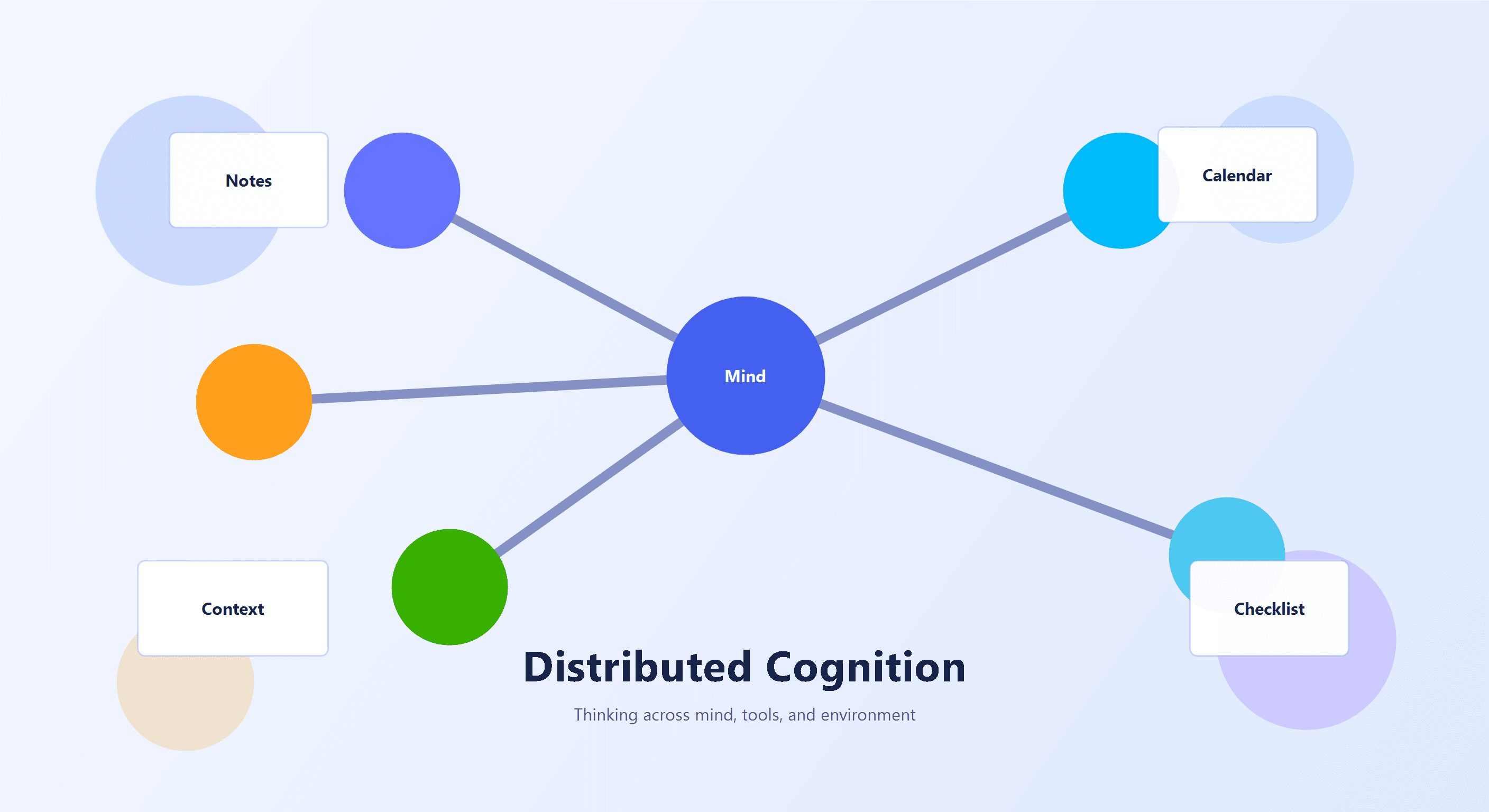
It is tempting to describe this as mere memory support, but that explanation is incomplete. In many cases, the external medium is not just storing information. It is becoming part of the workspace in which thinking unfolds. The concept of distributed cognition addresses precisely this point. On this view, cognition is not always confined to the brain; it can be organized across people, tools, environments, and social coordination (Hutchins, 1995).
This article examines what distributed cognition means, why tools such as notes, checklists, and calendars can sometimes support thought and sometimes create fragmentation, and what this implies for personal productivity systems.
What Is Distributed Cognition?
Traditional cognitive models often describe thinking as information processing that happens inside an individual mind. Distributed cognition does not deny that internal cognition matters. Rather, it argues that in many real-world tasks, important parts of cognitive work are organized beyond the individual: across people, artifacts, representations, procedures, and environments.
Drawing on studies of navigation and work environments, Hutchins showed that successful performance in complex settings cannot be understood solely as the product of one person's internal calculations. Instead, cognition is often best understood at the level of a system composed of people, tools, and structured practices (Hutchins, 1995).
This does not mean that tools replace the mind. It means that the mind often works by using stable external structures. Cognition remains human, but it is frequently scaffolded by the world.
Thinking Often Relies on the Environment
The clearest examples come from demanding work settings. Aircraft cockpits, ship navigation, and medical checklists do not depend on one person remembering everything internally. Gauges, displays, markings, procedures, and verbal confirmation all help structure attention and reduce error.
A cockpit display, for example, is not merely showing data. It is part of the interface through which pilots interpret the current state and coordinate next actions. A checklist is not simply a support for weak memory. It is a way of stabilizing critical procedural information outside the head so that the task can be carried out more reliably.
The same logic applies in everyday life. A calendar externalizes time. Notes preserve context. A whiteboard turns relationships into visible structure. These tools are useful not only because they help us avoid forgetting, but because they make comparison, reorganization, and coordinated reasoning easier than when everything is held internally.
Externalization Is Not the Same as Distributed Cognition
This is where the topic needs to be distinguished from some of our earlier posts. As discussed in Why Tasks, Goals, and Memory Should Be Managed Separately, people use the environment to reduce cognitive demands through notes, reminders, schedules, and other aids. Risko and Gilbert describe this as cognitive offloading (Risko & Gilbert, 2016).
But not every act of externalization amounts to distributed cognition.
- Writing something down anywhere: externalization
- Organizing that information so it can later support judgment, recall, and action: closer to distributed cognition
This distinction matters. A large number of notes does not automatically mean that thinking is being well supported. If notes, calendars, chats, and documents remain disconnected, then externally stored information may become fragmented rather than useful. In that case, the burden is not eliminated. It is merely deferred to a future self who must search, reconstruct, and reconnect it.
The key issue is therefore not simply getting information out of the head. The key issue is whether externalized information can be brought back into the flow of thinking in a structured way.
When Do Tools Help Thinking, and When Can They Hurt?
Using external tools is not always beneficial. Dunn and Risko argue that cognitive offloading is tied to metacognitive judgment: people decide what to keep in mind and what to place in the environment partly based on task difficulty, effort, and beliefs about their own memory performance (Dunn & Risko, 2016).
This suggests two things.
First, externalization is not necessarily a sign of laziness. It can be a rational strategy for handling demanding cognitive tasks more reliably. Second, its effectiveness depends in part on trust in the tool. Weis and Wiese found that people adjust their use of external aids not only based on actual reliability but also on what they believe the tool's reliability to be (Weis & Wiese, 2019).
A good tool, then, is not merely a feature-rich one. It must feel dependable enough that users are willing to rely on it, and it must allow stored information to be found and used later. Systems that make capture easy but retrieval and reconnection difficult may feel helpful at first while gradually increasing long-term cognitive friction.
What This Means for Personal Productivity Systems
From this perspective, a productivity system is not merely a storage device. It is an interface through which a person decides how thinking will be distributed across internal attention and external structure.
For example:
- Tasks function as an interface for immediate action.
- Goals function as an interface for direction and criteria.
- Memories function as an interface for future context and reference.
If these different roles are mixed into a single undifferentiated list, information may be externalized without becoming cognitively useful. The result is often not a thinking tool but a cluttered archive. This connects with the limits of working memory discussed in Chunking: a good external system is not one that merely stores more, but one that presents the right units for current judgment.
Likewise, as discussed in The Zeigarnik Effect, recording unfinished tasks in a trusted system can reduce open loops. But again, recording alone is not enough. The item must be structured as a next action, a long-term direction, or a contextual memory if the system is to provide real cognitive support.
How to Think About Memory Agent
In this light, it is more accurate to describe Memory Agent not as a dramatic "second brain," but as a distributed cognition interface that separates and reconnects different roles of information.
When inputs are distinguished as tasks, goals, or memories, several things become easier:
- what requires action now does not get mixed with what is merely reference,
- long-term direction remains connected to immediate action,
- stored context can be retrieved and reused when needed.
This is different from claiming that AI "does the thinking" for the user. A more defensible claim is that the tool helps structure an external workspace in which the user's own thinking can proceed with less friction. The benefits of writing discussed in Neuroscience-Based Inner Communication can also be understood in this way: internal states become externally representable and therefore more workable.
Conclusion
Humans have long thought with tools. Paper, tables, maps, checklists, calendars, and note systems are not merely aids for weak memory. They are external structures that help cognition remain stable in a complex world.
The central insight of distributed cognition is simple: the real question is not whether information should remain inside or outside the head. The real question is whether information placed outside the head can be organized so that it re-enters the flow of judgment and action when needed.
A good system is not one that stores the most information. It is one that allows stored information to function again as action, direction, and context. Personal productivity tools are no exception. Well-designed tools do not replace thought. They provide an environment in which thought can move more clearly.
Try connecting tasks, goals, and memory more structurally with Memory Agent →
References
-
Hutchins, E. (1995). Cognition in the Wild. MIT Press. https://doi.org/10.7551/mitpress/1881.001.0001
-
Clark, A., & Chalmers, D. J. (1998). The extended mind. Analysis, 58(1), 7-19. https://doi.org/10.1093/analys/58.1.7
-
Risko, E. F., & Gilbert, S. J. (2016). Cognitive offloading. Trends in Cognitive Sciences, 20(9), 676-688. https://doi.org/10.1016/j.tics.2016.07.002
-
Dunn, T. L., & Risko, E. F. (2016). Toward a metacognitive account of cognitive offloading. Cognitive Science, 40(5), 1080-1127. https://doi.org/10.1111/cogs.12273
-
Gilbert, S. J., Bird, A., Carpenter, J. M., Fleming, S. M., Sachdeva, C., & Tsai, P.-C. (2020). Optimal use of reminders: Metacognition, effort, and cognitive offloading. Journal of Experimental Psychology: General, 149(3), 501-517. https://doi.org/10.1037/xge0000652
-
Weis, P. P., & Wiese, E. (2019). Using tools to help us think: Actual but also believed reliability modulates cognitive offloading. Human Factors, 61(2), 243-254. https://doi.org/10.1177/0018720818797553