Tasks, Goals, and Memory: Why They Should Not Live in the Same List
Introduction: Why One List Eventually Starts Working Against You
Many people try to become more productive by putting everything into one app, one inbox, or one master list. Meeting notes go there. Long-term ambitions go there. Today's tasks go there. At first this feels efficient. Over time, though, the list becomes harder to act on. Small urgent items crowd out important goals, and useful notes become harder to retrieve when needed.
The issue is often not a lack of discipline. It is that different kinds of cognitive objects are being treated as if they were the same thing. In personal productivity systems, three categories are commonly mixed together: tasks, goals, and memory.
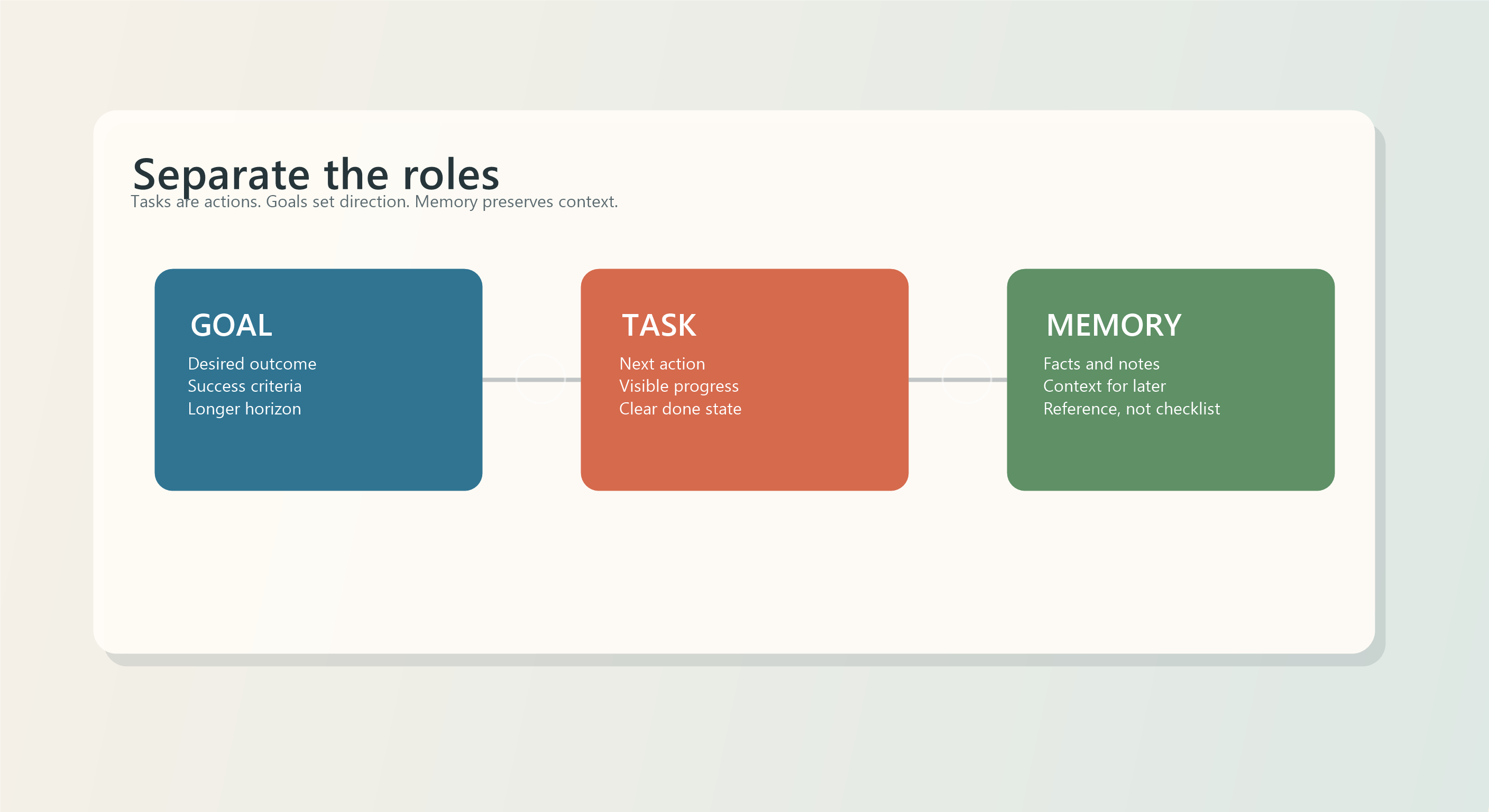
- A task is an action you can execute in the near term.
- A goal is a higher-level direction or desired outcome.
- A memory is information you may need to recall later: facts, context, feedback, or insights.
All three matter. But they do not play the same role in cognition. This article explains why separating them usually produces a cleaner and more usable system.
Goals Provide Direction; Tasks Create Movement
Goals and tasks are closely related, but they are not interchangeable. A goal answers the question, "What are we trying to achieve?" A task answers, "What should happen next?"
Goal-setting theory, as summarized by Locke and Latham, shows that specific and challenging goals can improve performance under the right conditions (Locke & Latham, 2002). But a goal is not the same thing as an executable action. "Improve my English," "finish a paper," or "recover my health" can organize effort, yet none of those statements tells you exactly what to do in the next ten minutes.
That gap matters. Gollwitzer's work on implementation intentions argues that goals become more actionable when they are linked to concrete situational plans: when, where, and how a response will happen (Gollwitzer, 1999). "Get healthier" is a goal. "Walk for 20 minutes at 7 a.m. on Monday, Wednesday, and Friday" is much closer to a task plan.
This distinction helps explain three common failure modes:
- If you have goals without tasks, you have direction without traction.
- If you have tasks without goals, you can stay busy without knowing whether the work matters.
- If both live in the same undifferentiated list, urgency and importance start competing in confusing ways.
That is why many strong systems separate "projects or goals" from "next actions." This is not just a preference in interface design. It reflects a real difference in the kind of cognitive work each item is supposed to do.
Memory Is Not an Action Item
The third category, memory, is often treated even more loosely. Many people store notes in the same place as tasks because both are "things I do not want to lose." But memory usually is not a command for action. It is stored context for future judgment and recall.
Consider the difference among these examples:
- "Call the accountant on Wednesday at 3 p.m." -> task
- "Stabilize the tax workflow for Q2" -> goal
- "The accountant said last year's receipt categories still apply this year" -> memory
The third item is not something to check off. It is context that can improve a later decision. If that kind of information sits inside an action list, the list gradually loses its action-oriented structure.
Risko and Gilbert frame this more broadly as cognitive offloading: people use the environment to reduce cognitive demand, including notes, reminders, schedules, and digital tools (Risko & Gilbert, 2016). The key point is not that externalization is bad. It is that different things should be externalized in different forms.
Memory works best when it is stored in a place designed for retrieval and context. Tasks work best when they are stored in a place designed for execution. When both are forced into the same format, neither is served well.
What Breaks When You Mix Them
It is not always wrong to view tasks, goals, and memory on one screen. The problem appears when they are handled as if they are the same type of item.
1. Prioritization Gets Noisy
An action list is usually meant to answer a practical question: what should I do first? But if the list contains goals and reference notes as well, you end up comparing items that do not belong on the same scale.
- "Write one page of the report"
- "Prepare for a career transition"
- "Budget constraint noted by the team lead in today's meeting"
All three may be important. But they cannot be sorted, executed, or completed in the same way. One is an action, one is a direction, and one is context.
2. Goals Never Get Properly Translated into Action
Goals are often too abstract to function as start signals. Implementation-intention research suggests that action is more reliable when a goal is converted into a concrete cue-response plan (Gollwitzer, 1999). If a goal stays at the level of aspiration, it may remain psychologically important without ever entering the schedule.
This is closely related to what we discussed in our post on the Zeigarnik Effect. An unfinished goal can keep returning to mind, but if no next action is defined, it generates tension without much progress. Not every goal needs to be fully decomposed immediately, but most active goals benefit from at least one clearly visible next step.
3. More Captured Information Does Not Automatically Mean Better Recall
Writing something down does not guarantee that it will be easy to find or use later. External reminders can support future remembering, but their effects depend on how the cue is structured and how well it matches the task. Henry and colleagues found that reminders can improve prospective memory performance, but the effect depends on the relationship between reminder and action structure (Henry et al., 2012). So "just capture everything" is too simplistic.
For stored memory to remain useful, at least one of the following should usually be clear:
- whether it is a factual note
- whether it is a reason behind a decision
- whether it is a reference to revisit later
- whether it belongs to a specific task or goal as supporting context
An undifferentiated inbox makes capture easy, but often shifts the retrieval cost onto your future self.
A Practical Rule: Is This an Action, a Direction, or a Reference?
In daily use, simple diagnostic questions are more helpful than abstract theory. When a new item comes in, try asking:
1. Can I finish this by doing it?
If yes, it is probably a task. A task usually has a clear completion condition. "Grow the business someday" does not.
2. Does this explain why the work matters?
If yes, it is probably a goal. A goal defines direction, success criteria, or a desired future state. It usually generates multiple tasks rather than being one.
3. Is this information I may need to recall later?
If yes, it is probably memory. Memory items benefit more from context, links, tags, and searchability than from checkboxes.
Once you make that distinction, the management rules also become clearer:
- Tasks should be short, actionable, and tied to time or context.
- Goals should express direction, criteria, and current stage.
- Memory should preserve context, source, and retrievability.
The central point is simple: you can store everything in one ecosystem, but you should not treat everything as the same structure.
Applying This in MemoryAgent: Separate, Then Connect
From a MemoryAgent perspective, a strong system does not require complete isolation among tasks, goals, and memory. It requires separation with meaningful links.
When an incoming item is classified correctly, several benefits follow:
- goals preserve longer-term direction
- tasks remain executable in the present
- memory supports later judgment and context recovery
For example, "I want to become more confident in English presentations this year" is a goal. "Revise one minute of next week's presentation script" is a task. "In the last presentation, I was told I speak too fast" is memory. These items should be connected, but they should not all be treated like generic checklist entries.
This also has a metacognitive advantage. As discussed in our post on Metacognition, clarity about what kind of item you are looking at reduces decision fatigue. Productivity often improves not because we capture more information, but because we assign each item a clearer role.
Conclusion
Tasks, goals, and memory are all valuable, but they serve different functions. Goals provide direction. Tasks generate action. Memory preserves context for the future. When we mix them indiscriminately, we end up expecting immediate action from strategic statements, using checklists as note archives, and hiding useful context inside cluttered task lists.
The better approach is modest but powerful: when something enters your system, first ask whether it is an action, a direction, or a reference. Put it into the right structure, then connect it to the related items when needed. A stable productivity system is not one that throws everything into a single bucket. It is one that lets different cognitive functions coexist without interfering with one another.
Try organizing your tasks, goals, and memory separately in MemoryAgent ->
References
-
Locke, E. A., & Latham, G. P. (2002). Building a practically useful theory of goal setting and task motivation: A 35-year odyssey. American Psychologist, 57(9), 705-717. https://pubmed.ncbi.nlm.nih.gov/12237980/
-
Gollwitzer, P. M. (1999). Implementation intentions: Strong effects of simple plans. American Psychologist, 54(7), 493-503. https://doi.org/10.1037/0003-066X.54.7.493
-
Risko, E. F., & Gilbert, S. J. (2016). Cognitive offloading. Trends in Cognitive Sciences, 20(9), 676-688. https://pubmed.ncbi.nlm.nih.gov/27542527/
-
Henry, J. D., Rendell, P. G., Phillips, L. H., Dunlop, L., & Kliegel, M. (2012). Prospective memory reminders: A laboratory investigation of initiation source and age effects. Quarterly Journal of Experimental Psychology, 65(7), 1274-1287. https://pubmed.ncbi.nlm.nih.gov/22489707/