Sleep Deprivation Erases What You Learned Yesterday: The Science of Sleep and Memory Consolidation
Introduction: Why Does an All-Nighter Vanish in the Exam Room?
Anyone who has crammed through the night before an exam knows the feeling. At 4 a.m. the material was clearly in your head — yet the moment the exam paper lands on your desk, it slips away like fog. We usually blame nerves or exhaustion. Those play a role, but there is a more fundamental cause: that memory was never finished in the first place.
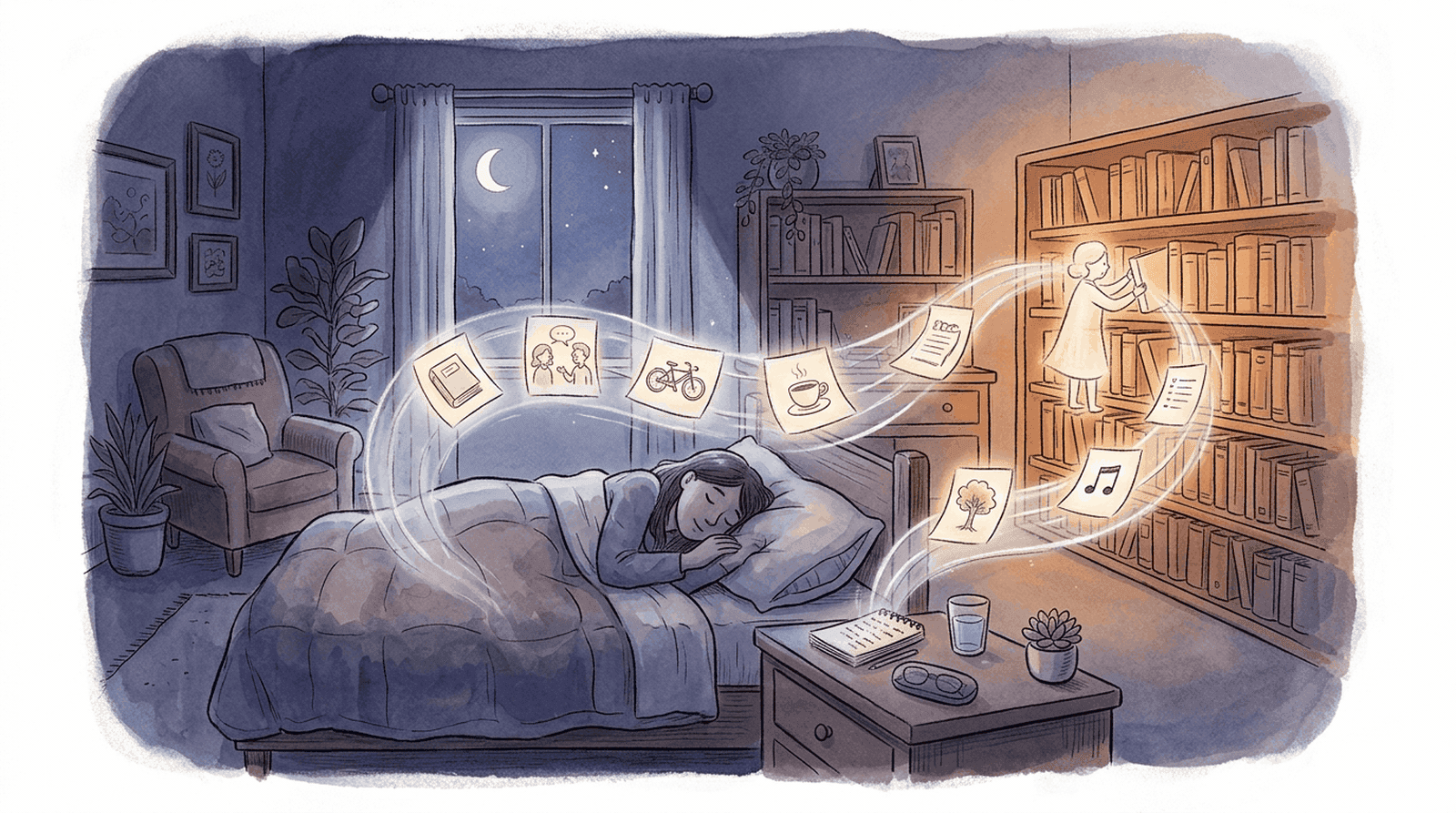
Memories are not made at the desk. The desk produces only a draft. The work of transcribing that draft into long-term memory — the process cognitive science calls consolidation — happens to a large degree while you sleep. Pulling an all-nighter means skipping that transcription process entirely.
This article follows roughly a hundred years of research on sleep and memory to answer three questions. What is the sleeping brain actually doing? How exactly does sleep loss damage memory? And what practical prescriptions can you apply starting tonight?
Memory Is Finished in Your Sleep — The Birth of Consolidation
The concept of consolidation was first proposed in 1900 by the German psychologists Georg Elias Müller and Alfons Pilzecker (Müller & Pilzecker, 1900). They discovered that new information arriving right after learning disrupts memory for what was just studied (retroactive interference), and concluded that memories are not fixed the instant they are "saved" but harden gradually over time.
The first experimental evidence that sleep is critical to this hardening came in 1924. John Jenkins and Karl Dallenbach at Cornell had students memorize nonsense syllables, then either sleep or stay awake (Jenkins & Dallenbach, 1924). The result was unambiguous: after the same amount of elapsed time, recall in the sleep condition was nearly twice as high as in the waking condition. Eight waking hours wiped out roughly 90% of the material; eight sleeping hours preserved more than half.
The interpretation at the time was modest: sleep simply blocks new experiences, so there is no interference. The steep decline of the Ebbinghaus forgetting curve flattens during sleep, the thinking went, merely because sleep is "quiet time." But the following eighty years of research revealed that the sleeping brain is not quiet at all — it is remarkably busy.
The Brain's Late-Night Rebroadcast: Hippocampal Replay
In 1994, Matthew Wilson and Bruce McNaughton at the University of Arizona implanted electrodes in rats' hippocampi and trained the animals on a maze (Wilson & McNaughton, 1994). As a rat passed each location in the maze, specific neurons fired in a fixed sequence. The astonishing part came afterward: once the rat fell asleep, the same neurons that had fired during the day's maze runs began firing again, in the same order. The sleeping brain was running a "replay" of the day's experience.
This discovery became the foundation of today's dominant framework, active systems consolidation (Diekelmann & Born, 2010; Rasch & Born, 2013). Its core claims:
- The hippocampus is temporary storage. The day's experiences are recorded there quickly but unstably — and capacity is limited.
- Transfer happens during deep (slow-wave) sleep. At night, the hippocampus replays the day's records at greatly accelerated speed while gradually copying them into the neocortex's long-term networks. Three rhythms — slow oscillations, sleep spindles, and hippocampal sharp-wave ripples — interlock precisely to drive this process.
- Selection happens at the same time. Not every experience is transferred equally. Emotionally charged memories, memories tagged as relevant for the future, and reward-linked memories are preferentially replayed and strengthened.
By analogy, the hippocampus is a stenographer's notepad filled throughout the day, and sleep is the night shift that selects, transcribes, and files those notes into the archive. An all-nighter means skipping the night shift while the notepad is already full. The next day there is no room left on the pad — and nothing from yesterday in the archive.
The Double Loss of All-Nighters: Yesterday's Memory and Tomorrow's Learning
The cost of sleep loss does not end with failed consolidation of yesterday's material. Matthew Walker's team at UC Berkeley showed that sleep deprivation also cripples the ability to learn anything new the next day (Yoo, Hu, Gujar, Jolesz, & Walker, 2007). Participants who stayed up all night encoded new pictures into memory about 40% less effectively than rested controls, and fMRI showed markedly reduced encoding activity in the hippocampus. An all-nighter is thus a double loss — yesterday's memory (consolidation) and tomorrow's memory (encoding) both suffer.
The same holds for motor skills. In Walker's finger-tapping experiments, participants became about 20% faster the morning after a night of sleep, without any additional practice (Walker, Brakefield, Morgan, Hobson, & Stickgold, 2002). An equivalent period spent awake produced no such gain. Skill keeps improving "offline" during sleep after practice ends. Instruments, sports, typing — skills learned with the body quite literally improve while you sleep.
Naps work too. Sara Mednick's team showed that a 60–90 minute nap — long enough to include both slow-wave and REM sleep — produced memory improvements on a perceptual learning task comparable to a full night of sleep (Mednick, Nakayama, & Stickgold, 2003). In seasons when full nights are impossible, a post-learning nap is a legitimate second-best.
The Honest Boundaries of the Science
For balance, two caveats deserve mention. The big picture — sleep matters for memory — is solid, but the detailed mechanisms and effect sizes remain genuinely debated.
First, the mechanism debate. Alongside active systems consolidation, Giulio Tononi and Chiara Cirelli proposed the synaptic homeostasis hypothesis (SHY) (Tononi & Cirelli, 2014): wakefulness broadly strengthens synapses, and sleep downscales them globally to restore signal-to-noise. Selective strengthening through replay and global downscaling sound contradictory, but the prevailing view today is that both processes coexist.
Second, the effect-size debate. Reviewing the literature, Maren Cordi and Björn Rasch noted that sleep's memory benefits are not always as large or as stable as commonly reported, varying considerably with task type, age, and sleep quality (Cordi & Rasch, 2021). The accurate reading is not "one night of sleep automatically improves memory," but rather that chronic sleep loss erodes the foundation of the entire memory system.
In short, both the overclaim ("sleep is a magic memory switch") and the underclaim ("sleep is mere rest") conflict with the data. What is certain is this: both consolidation and encoding run on top of sleep, and removing that foundation destabilizes every other learning strategy.
Four Prescriptions You Can Apply Tonight
1. Treat sleep as the final stage of studying — and schedule it. An all-nighter before an exam, presentation, or interview wrecks input and storage simultaneously. Given the same six hours, "three hours of study plus sleep" beats "four hours of study plus an all-nighter" for next-day recall — a consistent implication of consolidation research.
2. Place important learning close to bedtime. A shorter gap between learning and sleep tends to mean less interference and a larger consolidation benefit. A light 20–30 minute review before bed — ideally using active recall — is an effective way to tag the day's key memories for priority transfer.
3. Keep a regular sleep schedule. Consolidation divides its labor between slow-wave sleep (concentrated early in the night) and REM sleep (concentrated late). Irregular bedtimes or shortened nights amputate specific stages entirely. That is why a consistent rhythm matters as much as the 7–9 hour total.
4. Spend five minutes before bed moving your to-dos out of your head. Michael Scullin's team at Baylor used polysomnography to show that participants who spent five minutes before bed writing a concrete to-do list for tomorrow fell asleep on average nine minutes faster than those who wrote about tasks already completed (Scullin, Krueger, Ballard, Pruett, & Bliwise, 2018). The more specific the list, the stronger the effect. As we saw with the Zeigarnik effect, unfinished tasks keep occupying the brain — and the act of recording them externally releases that occupation, letting the brain power down with confidence.
Empty Your Head So the Brain Can Start Its Night Shift
That fourth prescription lands exactly where this series keeps arriving. What you need in order to fall asleep is not willpower but the assurance that "even if I forget, the system remembers." A brain that lies in bed replaying "I have to do that thing tomorrow" stops the loop the moment that item is moved to a trusted external store.
This is where MemoryAgent's aim — a quiet helper that remembers on your behalf — connects to sleep. Capture the to-do or the worry the moment it surfaces, and the system manages it as deadlines and schedules; you don't have to carry it to bed. And when spaced repetition resurfaces that memory tomorrow, in three days, and in a week, nighttime consolidation and daytime retrieval practice interlock — settling the memory into its most stable form. Becoming someone for whom it's okay to forget also means giving your brain back the room, every night, to do its own work.
Conclusion
- Memory is completed not at the moment of learning but during sleep. The core process is consolidation: the hippocampus's temporary records are transferred to and selected for the neocortex during deep sleep.
- An all-nighter is a double loss. Consolidation of yesterday's learning is cut off, and tomorrow's encoding capacity drops by roughly 40%.
- Procedural memories — sports, instruments — improve "offline" during post-practice sleep. Naps deliver part of the same benefit.
- Real academic debates remain about effect sizes and mechanisms, but the conclusion that chronic sleep loss erodes the foundation of learning is robust.
- The five-minute habit of writing tomorrow's to-dos before bed measurably shortens the time to fall asleep. Emptying your head is the switch that starts the brain's night shift.
References
-
Jenkins, J. G., & Dallenbach, K. M. (1924). Obliviscence during sleep and waking. The American Journal of Psychology, 35(4), 605–612. https://doi.org/10.2307/1414040
-
Wilson, M. A., & McNaughton, B. L. (1994). Reactivation of hippocampal ensemble memories during sleep. Science, 265(5172), 676–679. https://doi.org/10.1126/science.8036517
-
Diekelmann, S., & Born, J. (2010). The memory function of sleep. Nature Reviews Neuroscience, 11(2), 114–126. https://doi.org/10.1038/nrn2762
-
Rasch, B., & Born, J. (2013). About sleep's role in memory. Physiological Reviews, 93(2), 681–766. https://doi.org/10.1152/physrev.00032.2012
-
Yoo, S.-S., Hu, P. T., Gujar, N., Jolesz, F. A., & Walker, M. P. (2007). A deficit in the ability to form new human memories without sleep. Nature Neuroscience, 10(3), 385–392. https://doi.org/10.1038/nn1851
-
Walker, M. P., Brakefield, T., Morgan, A., Hobson, J. A., & Stickgold, R. (2002). Practice with sleep makes perfect: Sleep-dependent motor skill learning. Neuron, 35(1), 205–211. https://doi.org/10.1016/S0896-6273(02)00746-8
-
Mednick, S., Nakayama, K., & Stickgold, R. (2003). Sleep-dependent learning: A nap is as good as a night. Nature Neuroscience, 6(7), 697–698. https://doi.org/10.1038/nn1078
-
Tononi, G., & Cirelli, C. (2014). Sleep and the price of plasticity: From synaptic and cellular homeostasis to memory consolidation and integration. Neuron, 81(1), 12–34. https://doi.org/10.1016/j.neuron.2013.12.025
-
Cordi, M. J., & Rasch, B. (2021). How robust are sleep-mediated memory benefits? Current Opinion in Neurobiology, 67, 1–7. https://doi.org/10.1016/j.conb.2020.06.002
-
Scullin, M. K., Krueger, M. L., Ballard, H. K., Pruett, N., & Bliwise, D. L. (2018). The effects of bedtime writing on difficulty falling asleep: A polysomnographic study comparing to-do lists and completed activity lists. Journal of Experimental Psychology: General, 147(1), 139–146. https://doi.org/10.1037/xge0000374