Does Poor Memory Mean Low Intelligence? — The Science of Why They're Different
Does Poor Memory Mean Low Intelligence?
Introduction: You Understood It Perfectly — So Why Can't You Remember?
You followed everything in the meeting. You grasped the key arguments, asked sharp questions, and even proposed a solution. But the next day, when someone asks "What did they say in yesterday's meeting?", your mind draws a blank.
The same thing happens when studying. Understanding the concept is no problem. You can explain the principle in your own words. But when the test asks for exact figures, proper nouns, or specific dates, you freeze.
When this pattern repeats, you naturally arrive at a conclusion: "I must not be very smart."
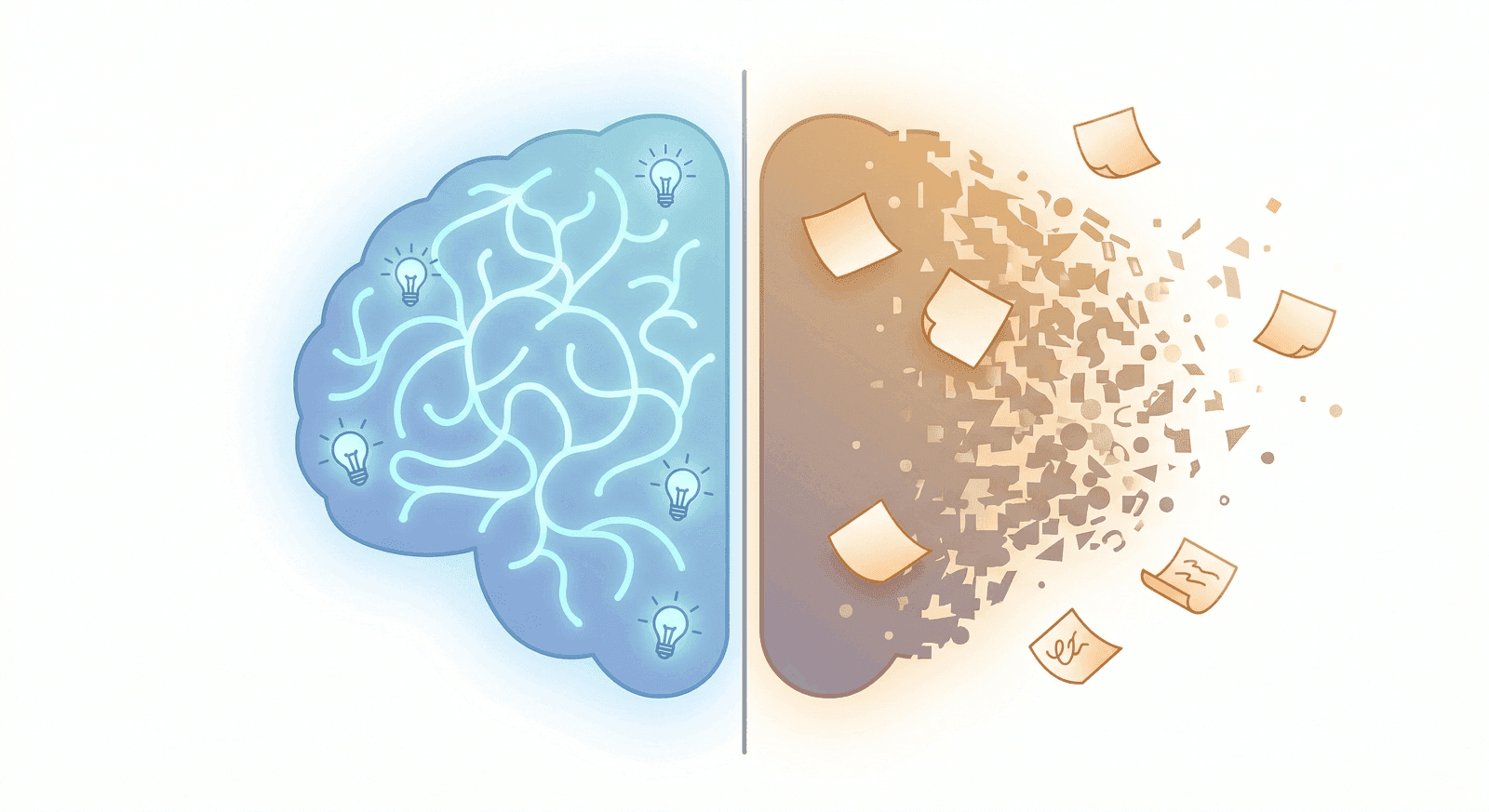
This article is here to show you, scientifically, that this conclusion is wrong. The ability to understand and the ability to remember are handled by different systems in the brain. A weakness in one does not imply a weakness in the other.
Intelligence Is Not One Thing: Cattell's Gf-Gc Theory
The phrase "being smart" is vague. In 1963, British psychologist Raymond Cattell proposed that intelligence is not a single ability but consists of at least two independent components (Cattell, 1963):
- Fluid Intelligence (Gf): The ability to identify patterns and reason logically in novel situations. It activates when you solve problems you have never encountered before.
- Crystallized Intelligence (Gc): Knowledge and skills accumulated through education and experience. It includes vocabulary, domain expertise, and cultural literacy.
An important distinction: Gc is not the same as "memorization ability." Gc is knowledge stored in long-term memory, but it does not increase simply by rote memorization — it grows through experience and understanding that become internalized. And while Gf and Gc are correlated, they can vary independently.
In other words, Cattell's theory says: "A person who excels at solving new problems does not necessarily remember everything well, and vice versa."
Intelligence Without Memory: The Evidence from Patient H.M.
The most dramatic evidence that intelligence and memory can be separated comes from the most famous patient in the history of neuroscience. Henry Molaison, known in research literature as Patient H.M., underwent surgical removal of his bilateral medial temporal lobes — including the hippocampus — in 1953 to treat severe epilepsy (Corkin, 2002).
What happened after the surgery was remarkable:
- He almost completely lost the ability to convert new experiences into long-term memories. He could not remember anything that happened after the operation.
- Yet his reasoning ability and verbal comprehension, as measured by IQ tests, remained within the normal range.
- Most memories formed before the surgery were preserved.
Decades of research on H.M. established one fact beyond doubt: The ability to form new memories and the ability to think and reason depend on different brain systems. The hippocampus is essential for forming new memories, but it is structurally separate from the frontal-parietal networks responsible for reasoning and judgment.
Similar evidence exists elsewhere. A 1997 study by Vargha-Khadem and colleagues examined patients who suffered hippocampal damage in early childhood. These patients had severely impaired episodic memory — the memory of personally experienced events — yet their factual knowledge (semantic memory) and intelligence were relatively preserved (Vargha-Khadem et al., 1997).
The message from this research is clear: Poor memory does not mean low intelligence. They are different abilities, handled by different brain regions.
Working Memory: Where Intelligence and Memory Intersect
If intelligence and memory are separate, why do we get the impression that "people with good memory are smart"? The answer lies in working memory.
Working memory, proposed by Baddeley and Hitch in 1974, refers to the cognitive system that temporarily holds and manipulates information (Baddeley & Hitch, 1974). It is what allows you to jot down a phone number while listening, or maintain the context of the beginning of a sentence while reading the end.
Engle's 2002 research showed that working memory capacity has a significant correlation with fluid intelligence (Gf) (Engle, 2002). People with greater working memory capacity performed better on complex reasoning tasks. This is why people with good working memory "appear smart."
But here is where the confusion arises. Working memory is the ability to hold and manipulate information in the short term. It is separate from the ability to store information long-term and retrieve it later. Understanding and responding to a meeting in real time is working memory. Recalling the details the next day is long-term encoding and retrieval.
A person who understands well but forgets later has working memory (comprehension and reasoning) that functions well, but experiences loss during the transfer to long-term memory. This is not a problem of intelligence — it is a characteristic of the memory system.
The Illusion That School Created
Much of why we equate "can't remember = can't do" traces back to the education system.
In 1985, Sternberg proposed the Triarchic Theory of Intelligence, challenging the limitations of what traditional IQ tests and school exams actually measure (Sternberg, 1985). He distinguished three dimensions of intelligence:
- Analytical intelligence: Logical reasoning, comparison, evaluation (what traditional IQ tests measure)
- Creative intelligence: The ability to cope with novel situations and generate original solutions
- Practical intelligence: The ability to adapt to real-world environments and solve everyday problems
Most school exams simultaneously test a subset of analytical intelligence and memory retrieval ability. "Define this term" appears far more often than "Explain this concept in your own words." As a result, test scores are heavily influenced by how well you can retrieve precise information, not just by how well you understand it.
The problem is that this experience becomes internalized over decades. Every time you could not write down an answer on an exam, every time you failed to recall a specific number in a meeting, the belief "I am not good enough" grew a little stronger.
But that was a characteristic of your memory system, not a deficiency in your intelligence.
The Brain Is Not a Storage Device
There is a fascinating study to consider. Sparrow and colleagues found in 2011 that when people were told certain information would be saved on a computer, they remembered less of the content itself but better remembered where it was stored (Sparrow et al., 2011).
This is called the Google Effect. When we know information is externally accessible, the brain prioritizes remembering the access path over the content. This is a digital extension of what social psychologist Wegner called transactive memory — instead of remembering everything ourselves, we remember "who (or what) knows it."
What this study suggests is that the brain is not a hard drive designed to faithfully store all information. The brain constantly chooses what to remember and what to discard for efficient resource allocation. And when a reliable external repository exists, the brain willingly offloads the storage burden.
The catch is that for this strategy to work, there needs to be an actually reliable external repository.
Conclusion: Your Brain Is Not at Fault
Here is the summary:
- Intelligence and memory are handled by different brain systems. Even when the hippocampus is damaged and no new memories can be formed, reasoning ability can be preserved.
- Working memory (comprehension and reasoning) and long-term memory (storage and retrieval) are separate processes. Understanding something well while failing to remember it later is a natural phenomenon.
- The brain was never designed to store everything. When a reliable external repository exists, the brain redirects its resources from storage to thinking.
Having a poor memory is not a lack of ability. Your brain is simply spending its resources on other things — understanding, connecting, and making judgments. Rather than blaming yourself, building an environment where memory can be offloaded is the wiser strategy.
How MemoryAgent Applies This
MemoryAgent is built on the principle that intelligence and memory are separate. It manages your memories and surfaces them when you need them, so your brain can focus on what it does best.
Learn more about MemoryAgent →
References
-
Cattell, R. B. (1963). Theory of fluid and crystallized intelligence: A critical experiment. Journal of Educational Psychology, 54(1), 1–22. https://doi.org/10.1037/h0046743
-
Corkin, S. (2002). What's new with the amnesic patient H.M.? Nature Reviews Neuroscience, 3(2), 153–160. https://doi.org/10.1038/nrn726
-
Vargha-Khadem, F., Gadian, D. G., Watkins, K. E., Connelly, A., Van Paesschen, W., & Mishkin, M. (1997). Differential effects of early hippocampal pathology on episodic and semantic memory. Science, 277(5324), 376–380. https://doi.org/10.1126/science.277.5324.376
-
Baddeley, A. D., & Hitch, G. (1974). Working memory. In G. H. Bower (Ed.), The Psychology of Learning and Motivation (Vol. 8, pp. 47–89). Academic Press. https://doi.org/10.1016/S0079-7421(08)60452-1
-
Engle, R. W. (2002). Working memory capacity as executive attention. Current Directions in Psychological Science, 11(1), 19–23. https://doi.org/10.1111/1467-8721.00160
-
Sternberg, R. J. (1985). Beyond IQ: A Triarchic Theory of Human Intelligence. Cambridge University Press. https://doi.org/10.1017/CBO9780511615771
-
Sparrow, B., Liu, J., & Wegner, D. M. (2011). Google effects on memory: Cognitive consequences of having information at our fingertips. Science, 333(6043), 776–778. https://doi.org/10.1126/science.1207745