The Action-Knowledge Loop: Why People Who Reflect After Doing Keep Growing
Introduction: Why Repeating the Same Thing Doesn't Make You Better
Ten years of experience doesn't always mean expertise. Doing the same thing for ten years and spending ten years trying slightly different approaches each time produce very different outcomes.
Some people give dozens of presentations yet still feel nervous every time. Others find their rhythm after just a few. Many of us finish a project vowing "I won't make that mistake again," only to repeat the exact same mistake on the next one.
The difference lies not in how much experience you have, but in what you do after the experience.
Education and organizational behavior research have long noted this distinction. It is not experience itself, but reflection on experience, that drives learning. This article explores why "looking back after doing" matters and how it changes the quality of your next action.
Experience Alone Doesn't Produce Learning
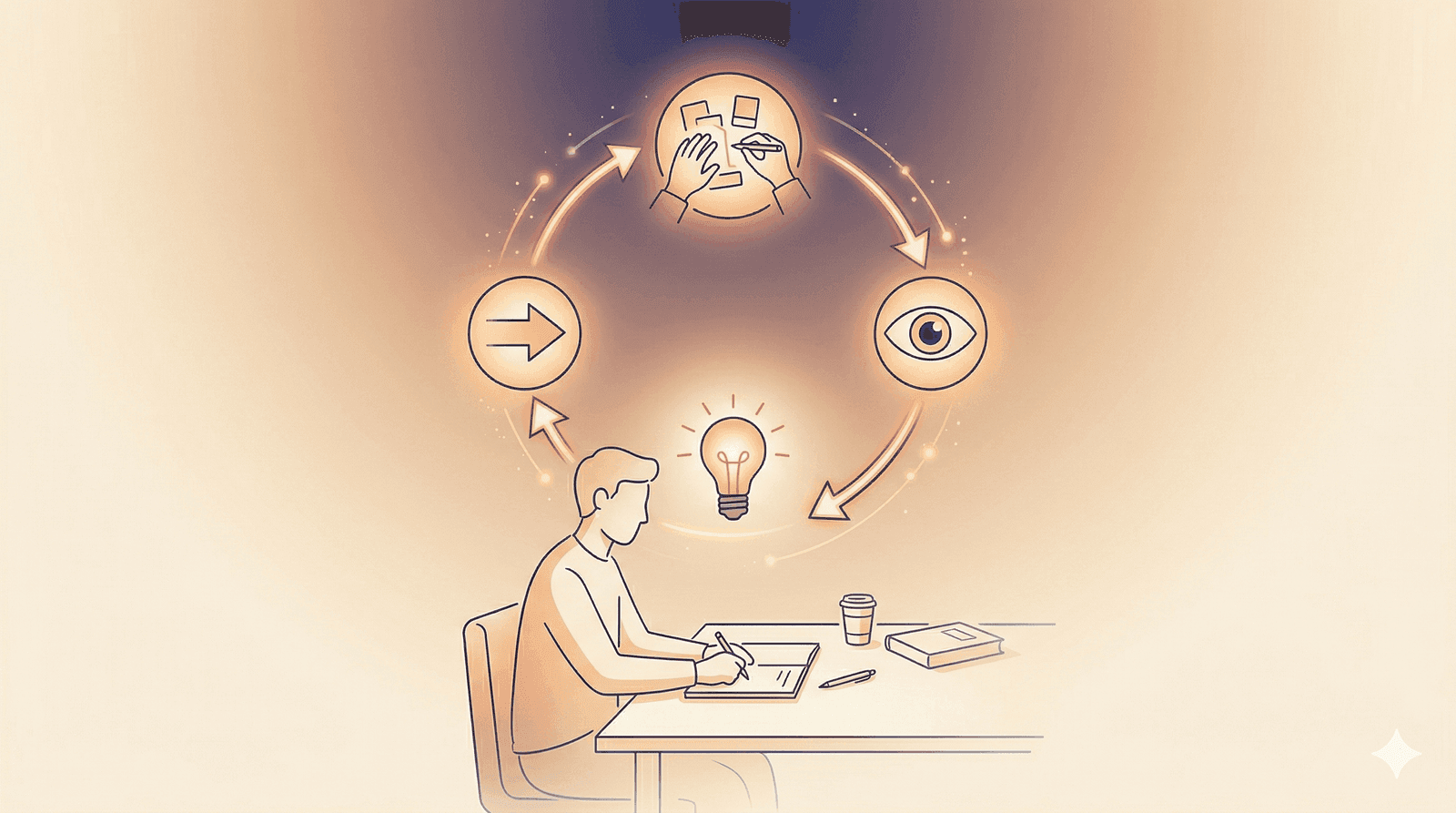
In 1984, David Kolb proposed his experiential learning theory, describing learning as a four-stage cycle (Kolb, 1984):
- Concrete Experience: You actually do something.
- Reflective Observation: You look back on that experience.
- Abstract Conceptualization: You extract principles or patterns from what you observed.
- Active Experimentation: You apply those principles to your next action.
Kolb's key insight is this: skipping from stage 1 (experience) directly to stage 4 (next action) makes learning difficult. Without stages 2 and 3 — reflecting and making sense — experience remains just an event that passed.
Think of a day packed with back-to-back meetings. If there's no time to consider what was said, what decisions were made, or what you missed, then no matter how many meetings you attend, you won't get better at them.
Reflection Can Be More Effective Than Extra Practice
"Wouldn't it be better to practice one more time instead of sitting and thinking?" There's an experimental answer to this question.
In a field experiment with new call center employees, Di Stefano, Gino, Pisano, and Staats at Harvard Business School found that a group that spent 15 minutes at the end of each day writing about what they learned performed 23% better than a group that used those 15 minutes for additional practice (Di Stefano et al., 2014).
Fifteen minutes. Just fifteen minutes at the end of the day spent writing "What did I learn today?" produced better results than spending the same time doing more work. The researchers attributed this effect to increased self-efficacy: reflecting helped participants recognize "I was able to do this today," which positively influenced the next day's performance.
This finding is worth noting precisely because it goes against intuition. Most professionals, when pressed for time, sacrifice "reflection time" first. Yet that time may be the most efficient learning interval available.
Structured Reflection Beats Unstructured Reflection
Knowing that reflection matters doesn't mean sitting down and vaguely "thinking about your day" will work well. Gibbs proposed a reflective cycle model in 1988 for educators and learners (Gibbs, 1988):
- Description: What happened?
- Feelings: What were you thinking and feeling?
- Evaluation: What was good and bad about the experience?
- Analysis: Why did things turn out that way?
- Conclusion: What else could you have done?
- Action Plan: What will you do differently next time?
This structure works because it naturally moves reflection from description to analysis, and from analysis to next action. It doesn't stop at "that went well" or "that went badly" — it pushes you toward "why" and "what next."
Donald Schön observed more broadly how professionals continuously learn through their experience. He called this reflection-in-action: experts monitor their own actions while performing them and adjust their approach in real time when results diverge from expectations (Schön, 1983). The difference between novices and experts lies not just in the amount of experience, but in the ability to reflect within experience.
How After-Event Reviews Change Future Performance
Military training and aviation have long systematically used After-Event Reviews (AER). Ellis and Davidi experimentally verified the effectiveness of this method.
In their study, groups that conducted structured after-event reviews following navigation training performed significantly better on subsequent tasks than those who did not. A particularly interesting finding was that reviews of successful experiences were just as effective as reviews of failures (Ellis & Davidi, 2005).
This carries an important implication. Many people associate "reflection" only with ruminating over failures. But successes are equally worth examining. The question "Why did that go well?" yields as many lessons as "Why did that go wrong?"
The basic structure of an after-event review is simple:
- What did you intend to do? (Intent)
- What actually happened? (Outcome)
- Why did it happen that way? (Cause)
- What will you keep and what will you change next time? (Lesson)
Writing these four lines takes five minutes. But the person who has this five-minute record and the person who doesn't are likely to produce different results from the same experience next time.
Why Recording Is Essential: The Limits of Mental Reflection
Even knowing reflection matters, most reflection happens only in our heads and then vanishes. We think "I'll do it differently next time," but when next time comes, we've forgotten the thought itself.
Flavell explained in his metacognition research that the human ability to be aware of and monitor one's own cognitive processes is important for learning and self-regulation (Flavell, 1979). But metacognition operates under working memory constraints. Simultaneously remembering multiple things, finding patterns among them, and planning for the future is a heavy load for the mind alone.
This is where recording comes in. Recording transforms reflection from a fleeting mental impression into externalized text. This creates three advantages:
- Defense against forgetting. Once written, thoughts can be retrieved even after they've faded from memory.
- Pattern discovery. As records accumulate, recurring patterns that weren't visible in individual experiences emerge. Tendencies like "I always change my plan right before the deadline" or "I can't start more than two new initiatives per month" are hard to recognize without records.
- Connection to next action. When you have a record saying "Last time I did this and got that result," it becomes evidence for your next plan. Relying only on memory leaves past experience as a vague impression; records turn it into a concrete reference point.
The Loop Never Stops
The essence of experiential learning is that this is not a one-time event but a recurring cycle. The flow of acting, reflecting, organizing, and applying doesn't end after one round.
The lesson from the first cycle becomes the starting point for the second action. Reflecting on the second action's results reveals layers that weren't visible in the first. As this process accumulates, what happens is not mere experience stacking but qualitative change.
Locke and Latham's goal-setting research showed that specific and challenging goals can improve performance (Locke & Latham, 2002), but there's an easily overlooked point here. A person who clearly knows why they set a goal — what happened before that led them in this direction — engages with the goal differently than someone who set it because "it seemed like a good idea."
Records of past experience become the rationale for the next goal. "Last month I aimed to exercise one hour daily but gave up after three days. Looking back, post-work fatigue was the cause. This time I'll try mornings." For this kind of loop to work, past experience and reflection on it must be preserved somewhere.
A Minimal Structure for Practice
Synthesizing the research covered in this article, activating the action-knowledge loop in daily life doesn't require an elaborate system.
1. Five Minutes at Day's End: Write Three Lines
Di Stefano's research showed results with 15-minute reflections. But it doesn't have to be 15 minutes. The key is the act of writing itself. These three lines are enough:
- One thing from today that stands out
- What went well and what didn't
- What to do differently tomorrow
2. Add "Why" When You Complete Something
Instead of just checking off a task and moving on, the habit of writing even one line — "What did I learn from doing this?" — creates a loop. Asking "why" about successes, not just failures, is the core lesson from Ellis and Davidi's research.
3. Use Records as Input for the Next Plan
The moment past records are referenced as evidence for the next plan, records transform from mere diary entries into action knowledge. If a note from three months ago influences today's decision, that is living knowledge.
Recording looks like an act of storing the past, but in reality, it is closer to an act of preparing for the future. When the cycle of looking back, organizing, and connecting to the next action repeats, the same amount of time produces different results. Growth comes not from doing more, but from properly reflecting on what you've done.
Start structurally connecting your memories and goals →
References
-
Kolb, D. A. (1984). Experiential Learning: Experience as the Source of Learning and Development. Prentice Hall. https://books.google.com/books/about/Experiential_Learning.html?id=zXruAAAAMAAJ
-
Di Stefano, G., Gino, F., Pisano, G. P., & Staats, B. R. (2014). Learning by Thinking: How Reflection Aids Performance. Harvard Business School Working Paper, No. 14-093. https://papers.ssrn.com/sol3/papers.cfm?abstract_id=2414478
-
Schön, D. A. (1983). The Reflective Practitioner: How Professionals Think in Action. Basic Books. https://doi.org/10.4324/9781315237473
-
Gibbs, G. (1988). Learning by Doing: A Guide to Teaching and Learning Methods. Oxford Polytechnic. https://reflection.ed.ac.uk/reflectors-toolkit/reflecting-on-experience/gibbs-reflective-cycle/
-
Ellis, S., & Davidi, I. (2005). After-event reviews: Drawing lessons from successful and failed experience. Journal of Applied Psychology, 90(5), 857-871. https://doi.org/10.1037/0021-9010.90.5.857
-
Flavell, J. H. (1979). Metacognition and cognitive monitoring: A new area of cognitive-developmental inquiry. American Psychologist, 34(10), 906-911. https://doi.org/10.1037/0003-066X.34.10.906
-
Locke, E. A., & Latham, G. P. (2002). Building a practically useful theory of goal setting and task motivation: A 35-year odyssey. American Psychologist, 57(9), 705-717. https://pubmed.ncbi.nlm.nih.gov/12237980/